
Blizzard Rustler 9 vs Salomon QST 100
Why You Can Trust Us
- Side-by-side analysis based on real user feedback
- Unbiased comparisons, not influenced by partnerships
- Updated as new data becomes available
We may earn from affiliate links at no extra cost to you.
| Rustler 9 | QST 100 | |
|---|---|---|
 | 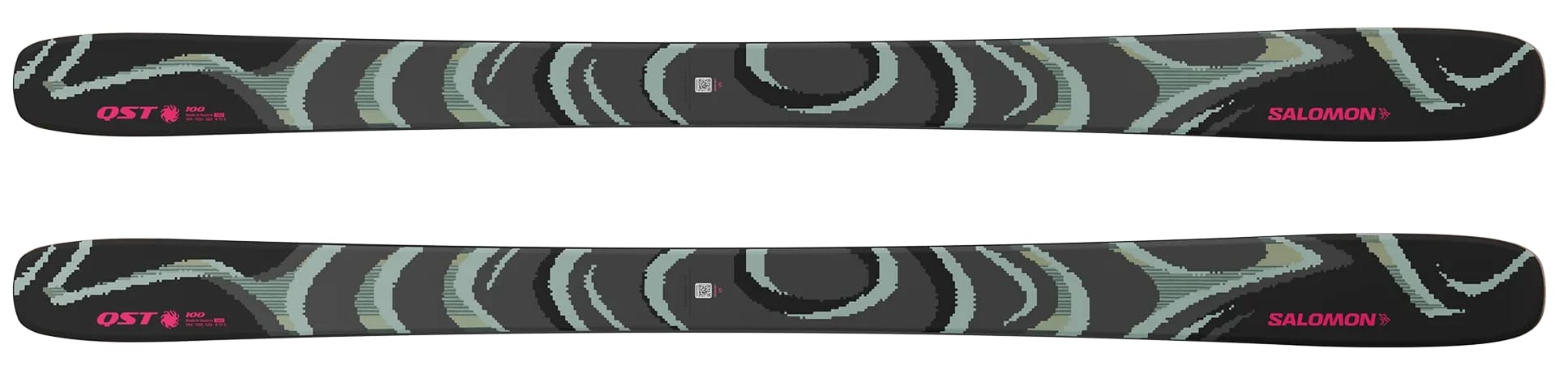 VS | |
| Waist Width | 96 mm | 100 mm |
| Turn Radius | 17 m at 180 cm | 17.5 m at 180 cm |
| Rocker Profile | Rockered tip, camber underfoot, rockered tail | Freeride profile (17% tip rocker, camber, 21% tail rocker) |
| Metal Layers | 1 (FluxForm Freeride titanal) | 1 (Ti Binding Reinforcement underfoot) |
| Length Range | 162-186 cm | 148-188 cm |
| Weight | 8.3 lb per pair at 180 cm | 4.1 lb per ski at 180 cm |
| Warranty | 1 Year | 2 Years |
| Sidecut Dimensions | 131.5-96-121 mm | 134-100-122 mm |
| Core Material | Trueblend Free woodcore (beech, poplar, paulownia) | Full poplar woodcore |
| Sidewall | Full ABS | Full sandwich |
| Blizzard Rustler 9 | Salomon QST 100 |
|---|---|
| |
| Waist Width | |
96 mm | 100 mm |
| Turn Radius | |
17 m at 180 cm | 17.5 m at 180 cm |
| Rocker Profile | |
Rockered tip, camber underfoot, rockered tail | Freeride profile (17% tip rocker, camber, 21% tail rocker) |
| Metal Layers | |
1 (FluxForm Freeride titanal) | 1 (Ti Binding Reinforcement underfoot) |
| Length Range | |
162-186 cm | 148-188 cm |
| Weight | |
8.3 lb per pair at 180 cm | 4.1 lb per ski at 180 cm |
| Warranty | |
1 Year | 2 Years |
| Sidecut Dimensions | |
131.5-96-121 mm | 134-100-122 mm |
| Core Material | |
Trueblend Free woodcore (beech, poplar, paulownia) | Full poplar woodcore |
| Sidewall | |
Full ABS | Full sandwich |
Stability
Rustler 9
QST 100
Stability matters in an all-mountain ski because it determines whether the ski stays composed when speed builds, snow gets rough, or you push hard through chatter. The Rustler 9 earns praise for an even flex and a damp, predictable feel, with buyers noting that it holds its line through aggressive skiing and resists washing out. The QST 100 scores higher, with buyers consistently describing basalt stringers and cork dampeners in the tip and tail that calm the ski at speed and a sturdier tail that helps it track true. The QST 100 does show some chatter on pure ice, which is a real limitation on hardpack days, but across mixed conditions it feels more composed. For a buyer who regularly skis fast on groomers or rough snow, the QST 100 is the safer choice, while the Rustler 9 still offers a stable, confidence-inspiring ride for strong skiers.
Edge Grip
Rustler 9
QST 100
Edge grip determines how confidently a ski bites and holds during carved turns on firm snow, which matters most for skiers who spend a lot of time on groomers. The Rustler 9 is a capable carver, with buyers praising its narrow profile and metal-over-edge construction for clean, precise turns and a solid bite on hard snow. The QST 100 receives more consistent praise, with buyers describing it as a very satisfying and extraordinarily good carving ski, and noting that its camber section feels locked in when carving and that it hooks just enough without feeling overly hooky. Notably, the QST 100 achieves this grip without a metal layer, which surprises many buyers. If carving on groomers is a priority, the QST 100 has the edge, while the Rustler 9 remains a strong option for skiers who want a narrower, more aggressive feel on firm snow.
Maneuverability
Rustler 9
QST 100
Maneuverability describes how easily a ski initiates turns, changes direction, and handles tight terrain such as trees, bumps, and short-radius runs. The Rustler 9 is genuinely playful, with buyers highlighting easy tail release, quick turn initiation, and especially good performance in bumps. Buyers do note that sizing up can dull its quickness, so a moderate length is recommended. The QST 100 is rated higher, with buyers describing it as very easy to steer through trees and tight spaces, quick to respond to initiated turns, and easy to throw sideways. Some feedback notes it still feels a little wiggly on flat base and that it is marginally less maneuverable than the QST 98, but overall the QST 100 is widely described as agile and turny. For skiers who prioritize quick, effortless turns in trees and bumps, the QST 100 is the stronger choice, while the Rustler 9 suits those who enjoy a playful, flick-the-tails feel.
Forgiveness
Rustler 9
QST 100
Forgiveness reflects how well a ski tolerates mistakes, absorbs terrain changes, and helps less experienced skiers stay in control. Both skis are rated in the middle range here, and neither is a beginner ski. The Rustler 9 is described as not overpowered for intermediates, which makes it manageable for skiers still building technique, though feedback on this aspect is limited and advanced skiers should expect a more demanding feel at speed. The QST 100 receives more positive feedback, with buyers noting softer tips and tails that add ease of use, a rocker profile that helps correct mistakes, and a ski that almost finishes the turn for you. It is also less approachable than the QST 98 and some buyers find it off-putting for true beginners. Intermediates looking for a forgiving all-mountain ski will likely find the QST 100 easier to live with, while the Rustler 9 is a reasonable choice for intermediates who want a lively ski.
Powder Performance
Rustler 9
QST 100
Powder performance matters because most all-mountain skiers want a ski that can handle fresh snow without sacrificing everyday performance. The Rustler 9 is described as drifty and smearable in soft snow, giving it a playful, floaty feel off-piste, but buyers describe it as a capable option for occasional powder days rather than a dedicated powder ski. The QST 100 is rated much higher in this area, with buyers repeatedly saying it floats incredibly well, never leaves them feeling short of flotation, and handles deeper areas and new snow in trees with ease. The broader tip shape and rocker are the main reasons, and buyers note it floats better than the QST 98 even at speed. If regular powder days are part of your plan, the QST 100 is the clear choice, while the Rustler 9 will be fine for the occasional soft-snow outing.
Versatility
Rustler 9
QST 100
Versatility is the core promise of an all-mountain ski, covering how well a ski handles different snow, terrain, and skier types within one setup. The Rustler 9 is a true one-ski quiver for many skiers, with buyers praising its twin-tip shape for switch riding and park features, its ability to handle groomers, freeride terrain, and mixed conditions, and its well-rounded character. The QST 100 is praised as one of the most versatile skis available, with buyers describing it as capable across nearly all snow conditions except pure blue ice, useful across a wide range of lengths, and suitable for a broad sweet spot of skier types. It is also described as freestyle-friendly and park-capable, though buyers note it is less focused on park-specific use than the Rustler 9. Both skis earn very high versatility ratings, so the choice depends on emphasis: the Rustler 9 for park and switch-focused all-mountain riding, and the QST 100 for broad, all-conditions coverage.
Trust & Transparency
- Data-driven rankings from real user reviews
- Affiliate partnerships don't influence our methodology
We may earn commission from links.
Conclusion & Final Verdict:
Pick the Blizzard Rustler 9 if you want a playful, twin-tip ski for switch riding, park laps, and quick turns in bumps, and you are comfortable with a moderate length and a more demanding feel at speed.
Pick the Salomon QST 100 if you want one ski that handles nearly everything, including confident carving, strong stability, excellent powder float, and easier forgiveness. It also has the longer warranty and wider length range, making it the stronger all-around choice for most all-mountain skiers. Just be aware it can chatter on pure ice.
Related Comparisons
Blizzard Rustler 9vsElan Ripstick 96 Black Edition
The Rustler 9 is the stronger choice for skiers who want one ski for groomers, freeride terrain, park and switch, with more stability and firmer-snow grip. The Ripstick 96 Black Edition suits agile skiers who want a lighter, quicker ski that also tours well.
Blizzard Rustler 9vsHead Kore 94 Ti
The Rustler 9 is the livelier, more playful ski, with stronger edge hold, quicker turns, and better off-piste float, which suits park, switch, and carving-focused skiers. The Kore 94 Ti is the calmer, damper, more forgiving choice that stays composed in chop and bumps for buyers who want one ski for unpredictable days.
Blizzard Rustler 9vsK2 Mindbender 96
The Rustler 9 is the more playful, versatile one-ski choice for skiers who want switch, park, and groomer performance with nimble turns and strong edge grip. The Mindbender 96 suits skiers who prioritize a quieter, more planted feel at speed and in chopped snow.
Blizzard Rustler 9vsLINE Pandora 99
The Rustler 9 is the better pick for firm-snow carving, stability at speed, and a true one-ski quiver, while the Pandora 99 is livelier and floatier in soft snow, trees, and tight terrain. Choose the Rustler if groomers and high-speed composure matter most, and the Pandora if you ski lots of powder and want quick, playful turns.
Blizzard Rustler 9vsNordica Santa Ana 92
The Rustler 9 is the more versatile one-ski quiver, with quicker, playful turns and stronger edge grip on firm groomers. The Santa Ana 92 suits advanced skiers who want a calmer, more planted, damped ride with better forgiveness.
Blizzard Rustler 9vsRossignol Sender 100
The Blizzard Rustler 9 is the stronger one-ski quiver for skiers who want a stable, predictable ski for groomers, freeride terrain, park laps, and switch riding. The Rossignol Sender 100 is the lighter, quicker choice for bumps, trees, and carving firm snow, and it is more forgiving when things go wrong.