
CAPiTA Mercury vs CAPiTA D.O.A.
Why You Can Trust Us
- Side-by-side analysis based on real user feedback
- Unbiased comparisons, not influenced by partnerships
- Updated as new data becomes available
We may earn from affiliate links at no extra cost to you.
| Mercury | D.O.A. | |
|---|---|---|
 |  VS | |
| Camber Profile | RESORT V2 | Resort V1 + Flat Kick Tech |
| Flex | 6.5 | TWIN 5.5 |
| Shape | Directional | TRUE TWIN |
| Waist Width | 147: 249 mm | 148: 244 mm |
| Ability Level | Intermediate to Advanced | Intermediate to Advanced |
| Size Range | 147 to 162W | 148–164, 151W–163W |
| Warranty | 2 Years | 2 Years |
| Sidecut Radius | 147: 7.15 m | 148: 7.6 m |
| Rider Weight | 80 to 220 lb | 148: 90–150 lb |
| Stance | 20 in to 23 in | 148: 20 in |
| Base | HYPERDRIVE™ Base (sintered polyethylene) | QUANTUM DRIVE™ running base |
| Core And Laminates | Core: HOVER CORE™; Laminates: HOLYSHEET™ Tri/Bi fiberglass with MAGIC BEAN™ resin | Core: P2 Superlight™ Core |
| Inserts | 2 × 4 | Not specified by CAPiTA |
| CAPiTA Mercury | CAPiTA D.O.A. |
|---|---|
| |
| Camber Profile | |
RESORT V2 | Resort V1 + Flat Kick Tech |
| Flex | |
6.5 | TWIN 5.5 |
| Shape | |
Directional | TRUE TWIN |
| Waist Width | |
147: 249 mm | 148: 244 mm |
| Ability Level | |
Intermediate to Advanced | Intermediate to Advanced |
| Size Range | |
147 to 162W | 148–164, 151W–163W |
| Warranty | |
2 Years | 2 Years |
| Sidecut Radius | |
147: 7.15 m | 148: 7.6 m |
| Rider Weight | |
80 to 220 lb | 148: 90–150 lb |
| Stance | |
20 in to 23 in | 148: 20 in |
| Base | |
HYPERDRIVE™ Base (sintered polyethylene) | QUANTUM DRIVE™ running base |
| Core And Laminates | |
Core: HOVER CORE™; Laminates: HOLYSHEET™ Tri/Bi fiberglass with MAGIC BEAN™ resin | Core: P2 Superlight™ Core |
| Inserts | |
2 × 4 | Not specified by CAPiTA |
Edge Control
Mercury
D.O.A.
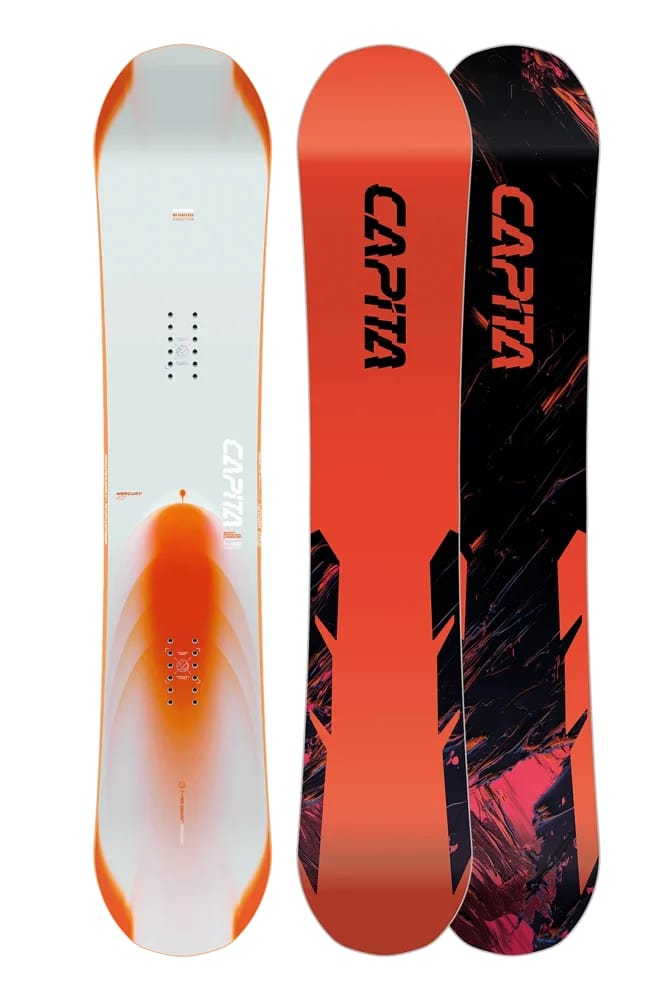
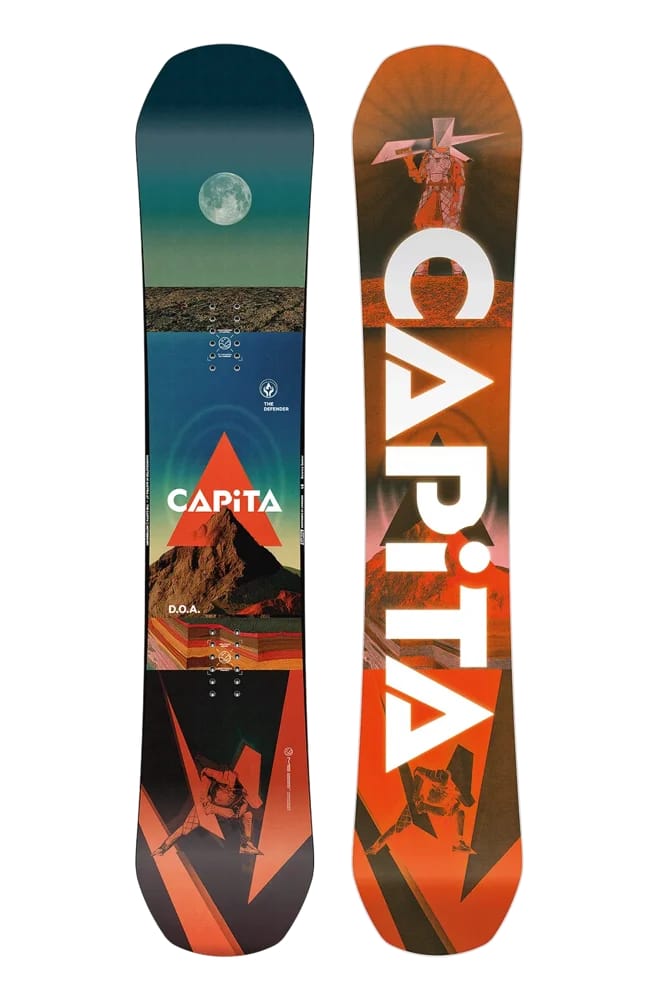
Edge control matters because it determines how confidently a board holds a carve on groomers, firm snow, and banked terrain, and how quickly it responds when you change direction. The Mercury's progressive side cut and death grip edge hold give riders confident bite when carving deeper or on firm snow, and many buyers say it turns easily across the mountain, including switch. Some riders find it slower to initiate edge-to-edge turns and report it can wash out on the heel side in thick cement, so it suits all-mountain carvers more than quick-turn specialists. The D.O.A. feels nimble and direct on quick, short carves and corduroy thanks to its carbon-reinforced construction, and riders describe its edge-to-edge response as controlled and precise. A minority wanted more bite and direction when pushing hard at speed, so it rewards riders who value responsive carving over aggressive grip. Overall the two boards are very close here, so the choice comes down to whether you prefer the Mercury's deeper, grippier carve or the D.O.A.'s quicker, more playful turn initiation.
Stability
Mercury
D.O.A.
Stability determines how planted a board feels at speed, through chop, and on landings, which is critical for confidence when you are pushing your limits. The Mercury earns strong praise here, with buyers consistently describing it as stable, predictable, and locked in across conditions and in the air, including on features of almost any size. Several riders note it feels precise and forgiving, though a few feel it could be even more planted when pushed hard. The D.O.A. also feels solid and centered underfoot, including in high-performance terrain and on landings, which helps it carry confidence at speed. Its tail is softer than the nose, however, and some buyers wished for a firmer back end, so expect a looser feel toward the rear. For most riders the Mercury offers the more consistent and confidence-inspiring platform, while the D.O.A. is still stable enough for confident all-mountain riding.
Smooth Ride
Mercury
D.O.A.
Smooth ride matters because a board that absorbs chop, uneven snow, and hard landings reduces fatigue over a full day. The Mercury's damp, flexible feel helps it stay composed over chop and messy snow, and many riders find it comfortable with knees bent. Some note harder hits on the uphill side and nose chatter that can come through, so the ride is firm but controlled rather than fully cushioned. The D.O.A. is soft, forgiving, and comfortable while cruising, skipping over push piles and uneven spots with a smooth, predictable feel. Its softer flex means hardcore riders chasing a damped, stiffer ride may find it less dampened than a firmer all-mountain board. Both boards handle chop capably, so the Mercury suits riders who want more damping and composure at speed, while the D.O.A. suits relaxed cruisers who prefer a forgiving, easygoing flex.
Speed
Mercury
D.O.A.
Speed matters for riders who want a board that holds momentum on groomers, through chop, and into jumps. The Mercury stands out with its Hyperdrive sintered base and energetic flex, and buyers say it stays fast all season and carries speed well into features. Riders describe it as matching however fast they ride and feeling good across a wide range of speeds, though it is less quick to initiate turns. The D.O.A. also rides well across a wide range of speeds with a fast base glide, and it feels fun and controllable at moderate pace. Its base needs regular waxing to reach peak speed, and it can feel less composed on high-speed jumps. For riders chasing pace and stability at higher speeds, the Mercury is the stronger option, while the D.O.A. works well for riders who are not chasing top-end speed.
Powder Float
Mercury
D.O.A.
Powder float matters for riders who want to enjoy fresh snow without switching boards. The Mercury handles powder well, with reverse-blend elevated contact points that help it float and ride playfully on deep days, and riders describe it as holding its own in deep snow. Light, dry snow offers less buoyancy, and the setback can make directional float feel less pronounced than dedicated powder boards. The D.O.A.'s powder performance is more mixed, with some riders describing a floaty, catch-free feel when stepping down lifts, while others say the nose sinks and they must shift weight onto the back foot to keep it up. Because the D.O.A. has less consistent powder feedback, treat it as a capable all-mountain option rather than a powder specialist. For deep days the Mercury is the clear pick.
Park Play
Mercury
D.O.A.
Park play matters most for freestyle riders who spend their time on jumps, rails, boxes, and jibs. The Mercury is a strong park choice with easy ollies, responsive butters, and solid press and rail control, and riders praise its switch riding overall, though a few note the nose and tail can feel odd in switch. The D.O.A. is a standout in the park, with strong pop, easy jibbing, and butters and presses that spring out cleanly thanks to its true twin shape with identical nose and tail. Riders consistently call it a go-to board for tech tricks, jumps, and confident hits on bigger features. Both boards are excellent in the park, so the difference is subtle: the Mercury feels like a freestyle-leaning all-mountain board, while the D.O.A. is more purely built for jibbing and twin-tip tricks. Pick the Mercury if you want a park board that also rips groomers, and the D.O.A. if the park is your main playground.
Trust & Transparency
- Data-driven rankings from real user reviews
- Affiliate partnerships don't influence our methodology
We may earn commission from links.
Conclusion & Final Verdict:
Choose the Mercury if you want a stable, fast, all-mountain board that rides confidently at speed, floats better in powder, and still delivers strong park performance. It is the better all-around pick for riders who push their pace and ride varied terrain.
Choose the D.O.A. if the park is your main playground and you prioritize jibbing, pop, and a true twin feel for tech tricks, jumps, and bigger features. It is also a comfortable, forgiving option for relaxed cruising, though it is less planted at high speed and less capable in deep snow.
Related Comparisons
CAPiTA D.O.A.vsGNU Banked Country
The CAPiTA D.O.A. is the better choice for park-first riders who want strong pop, easy jibbing, and a true twin shape. The GNU Banked Country suits advanced riders who prioritize locked-in carving, damped all-day comfort, and better powder float.
CAPiTA D.O.A.vsLib Tech Skunk Ape Camber
The CAPiTA D.O.A. suits park-focused riders who want strong pop, easy jibbing, and a softer, forgiving ride. The Lib Tech Skunk Ape Camber is the better choice for firm-snow carving, damped stability, and occasional powder days.
CAPiTA D.O.A.vsNever Summer Infinity
The CAPiTA D.O.A. is the better choice for park-focused riders who want strong pop, easy jibbing, and twin-tip tricks. The Never Summer Infinity suits riders who value stability, locked-in edge hold on firm snow, and a damp, comfortable ride across mixed terrain.
CAPiTA D.O.A.vsRIDE Warpig
The CAPiTA D.O.A. is the better pick for riders who spend most of their time in the park and want a playful, poppy twin. The RIDE Warpig suits all-mountain riders who want more float, a tight carving edge, and a board that works across a wider range of abilities.
CAPiTA MercuryvsBataleon Whatever
The CAPiTA Mercury is the stronger all-mountain choice for riders who want park pop, stability, and speed, while the Bataleon Whatever suits buyers who prioritize smoother comfort and playful soft-snow fun over firm-snow edge hold.
CAPiTA MercuryvsCAPiTA The Equalizer
The Mercury is the stronger all-mountain pick for riders who want stability, speed, and freestyle energy that holds up at pace, while the Equalizer suits riders who prioritize a smoother, buttery ride over bumps and chunder.