
Atomic Bent 100 vs Salomon QST 100
Why You Can Trust Us
- Side-by-side analysis based on real user feedback
- Unbiased comparisons, not influenced by partnerships
- Updated as new data becomes available
We may earn from affiliate links at no extra cost to you.
| Bent 100 | QST 100 | |
|---|---|---|
 | 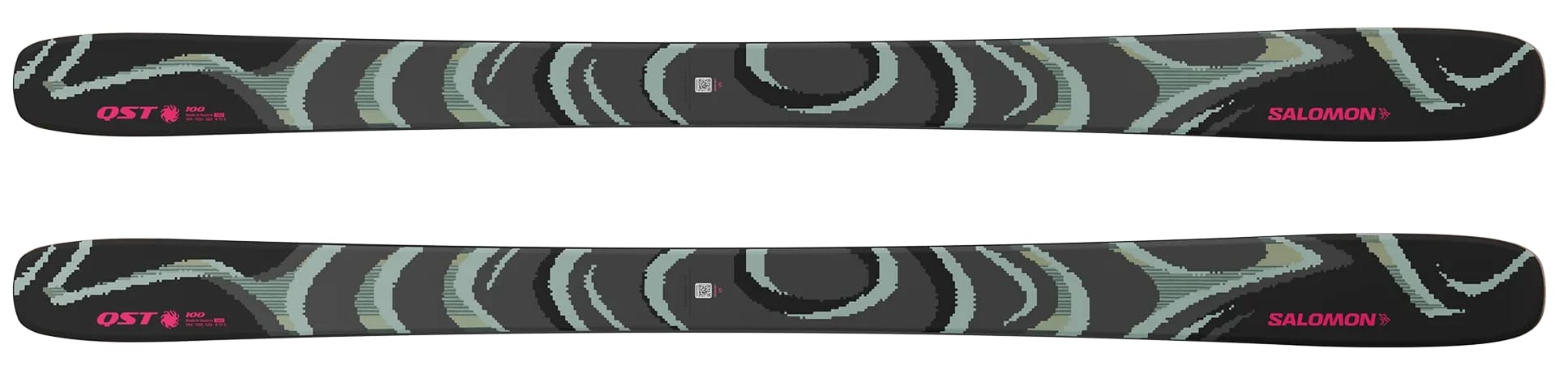 VS | |
| Waist Width | 100 mm | 100 mm |
| Turn Radius | 19 m at 179 cm | 17.5 m at 180 cm |
| Rocker Profile | Powder Rocker 20/65/15 (tip and tail rocker, camber underfoot) | Freeride profile (17% tip rocker, camber, 21% tail rocker) |
| Metal Layers | No metal | 1 (Ti Binding Reinforcement underfoot) |
| Length Range | 158-186 cm | 148-188 cm |
| Weight | 3.7 lb per ski at 179 cm | 4.1 lb per ski at 180 cm |
| Warranty | N/A | 2 Years |
| Sidecut Dimensions | 128.5-100-119 mm | 134-100-122 mm |
| Core Material | Light Woodcore (poplar wood core) | Full poplar woodcore |
| Sidewall | Duracap Sidewall | Full sandwich |
| Atomic Bent 100 | Salomon QST 100 |
|---|---|
| |
| Waist Width | |
100 mm | 100 mm |
| Turn Radius | |
19 m at 179 cm | 17.5 m at 180 cm |
| Rocker Profile | |
Powder Rocker 20/65/15 (tip and tail rocker, camber underfoot) | Freeride profile (17% tip rocker, camber, 21% tail rocker) |
| Metal Layers | |
No metal | 1 (Ti Binding Reinforcement underfoot) |
| Length Range | |
158-186 cm | 148-188 cm |
| Weight | |
3.7 lb per ski at 179 cm | 4.1 lb per ski at 180 cm |
| Warranty | |
N/A | 2 Years |
| Sidecut Dimensions | |
128.5-100-119 mm | 134-100-122 mm |
| Core Material | |
Light Woodcore (poplar wood core) | Full poplar woodcore |
| Sidewall | |
Duracap Sidewall | Full sandwich |
Stability
Bent 100
QST 100
Stability matters on an all-mountain ski because it decides whether the tips stay composed through chatter, crud, and fast groomer runs. The QST 100 is the clear leader here, with buyers repeatedly crediting its basalt stringers and cork dampeners in the tip and tail for a calm, damped feel at speed. Its sturdier tail also helps it track true and hold its line when the snow gets rough. The Bent 100 is no slouch, since it stays composed through chatter and holds its line on groomers, and most skiers will find it stable at their pace. Testers do note that it reaches a limit at very high speeds and lacks the same damped feel. The QST 100 also shows chatter on pure ice, so buyers who ski lots of blue ice should weigh that limitation. Aggressive or fast skiers should lean toward the QST 100, while more moderate skiers will likely be happy with the Bent 100.
Edge Grip
Bent 100
QST 100
Edge grip determines how much confidence you have when carving firm groomers and holding a line on hard snow. The QST 100 stands out here, with buyers describing it as a very satisfying carving ski that gives enough grip to rely on in a carve. Its camber section feels locked in on groomers, and the taper hooks just enough to allow clean carves without feeling overly hooky. Buyers also note that edge hold improves in the longer lengths. The Bent 100 can carve and holds an edge well enough on groomers, and it rails on edge when driven. However, reviewers say it lacks the bite of dedicated GS carvers, feels less grippy in the extremities, and can feel grabby underfoot. Skiers who prioritize carving on firm snow should choose the QST 100, while those who mainly ski relaxed groomers may find the Bent 100 sufficient.
Maneuverability
Bent 100
QST 100
Maneuverability matters because trees, bumps, and tight technical terrain demand quick turn initiation and low effort. The Bent 100 is light and playful, and buyers say it turns easily through trees and makes short slalom-style turns without much effort. Its tip taper also helps in softer snow, and the shorter radius allows clean carves. The QST 100 is equally impressive, with many buyers describing it as very easy to steer through trees and bumps, and some calling its agility off the charts. Its rocker profile makes turn initiation effortless, and it pops and snaps out of bumps while wiggling through tight spaces. A few buyers note that it can feel a little wiggly on flat base. Both skis excel here, so the choice comes down to feel: the Bent 100 for light, playful quickness, and the QST 100 for effortless, turny steering.
Forgiveness
Bent 100
QST 100
Forgiveness is important for skiers who sometimes sit back or get caught off balance, because a forgiving ski keeps mistakes from becoming falls. The Bent 100 feels forgiving and does not punish sitting back, especially from the tail, which makes it a confidence builder for freeride and freestyle skiing. The QST 100 offers similar ease, with softer tips and tails that make it easy to get back in control and let the ski almost finish the turn for you. Its rocker profile helps correct mistakes and absorbs terrain changes well. Some buyers find the QST 100 less approachable for true beginners, which is a reason to consider softer options if you are still building skills. Both skis land at the same forgiveness level, so intermediate skiers can choose based on whether they prefer a tail-friendly, playful feel or a ski that smooths out mistakes in the turn.
Powder Performance
Bent 100
QST 100
Powder performance matters because a ski that floats well keeps you on top of fresh snow instead of sinking into it. The QST 100 is the stronger floater, with buyers saying it floats incredibly well and they never felt a lack of flotation. Its broader tip shape gives it plenty of lift, and it handles deeper areas and fresh snow in trees with ease. The Bent 100 uses a convex tip to add flotation without extra width, so it handles deep powder well for its size. Some skiers still point to a wider ski for heavier powder days, and the Bent 100 is best when powder is an occasional treat rather than the main event. If you ski deep snow often, the QST 100 is the better choice, while the Bent 100 is a capable option for lighter, mixed conditions.
Versatility
Bent 100
QST 100
Versatility is the core reason most buyers consider either ski, since a one-ski quiver has to handle groomers, powder, trees, and park. The Bent 100 is widely described as one of the most versatile twin tips available, and buyers say it is not pigeonholed as a park ski. Its twin tip makes switch skiing easy, and it has a surfy, playful character that suits freestyle and freeride alike. The QST 100 is equally versatile, with buyers saying it handles nearly all snow conditions except pure blue ice and performs well across groomers, bumps, trees, and jumps. It works with alpine or tech bindings and comes in a wide range of lengths for many skier types. Its park use is less specialized, so park-focused riders may find it less suited. Both skis are excellent all-mountain choices, so the best pick depends on whether you lean toward playful twin-tip freestyle or a broader, more capable all-mountain ski.
Trust & Transparency
- Data-driven rankings from real user reviews
- Affiliate partnerships don't influence our methodology
We may earn commission from links.
Conclusion & Final Verdict:
Choose the Bent 100 if you want a light, playful, and quick twin tip for trees, bumps, park laps, and switch skiing, and you are an intermediate to advanced skier who values easy turn initiation over firm-snow grip. Choose the QST 100 if you want a more stable, better-carving all-mountain ski with stronger float and a broader length range, especially if you ski fast, carve groomers, or spend time in deep snow. Both skis are versatile one-ski options, so the best buy depends on whether you prioritize playful agility or composed all-mountain performance.
Related Comparisons
Atomic Bent 100vsLINE Pandora 99
The Bent 100 is the lighter, quicker twin tip for trees, park and all-around use, while the Pandora 99 offers more stability and edge grip at speed. Pick the Bent 100 for agile, lightweight skiing and the Pandora 99 for more confidence on firm snow and faster runs.
Atomic Bent 100vsNordica Enforcer 94
The Bent 100 is the lighter, more playful and more versatile choice for skiers who want one ski for trees, powder, park and groomers. The Enforcer 94 suits confident drivers who put a premium on damped stability and firm-snow edge grip at speed.
Atomic Bent 100vsNordica Santa Ana 92
Atomic Bent 100 is the lighter, more playful and more versatile twin tip for quick turns in trees, park and mixed terrain, suiting intermediate to advanced skiers. Nordica Santa Ana 92 is the more planted, damped and stable choice for advanced skiers who want firmer-snow edge hold and smooth rides at speed.
Atomic Bent 100vsRossignol Sender 100
The Atomic Bent 100 is the lighter, more playful choice for skiers who want quick turns through trees and a one-ski quiver for powder and park. The Rossignol Sender 100 suits skiers who prioritize firm-snow grip, stability at speed and composed carving.
Atomic Bent 100vsStöckli Stormrider 88
The Atomic Bent 100 is the lighter, quicker twin tip for skiers who want one playful ski for trees, park, and mixed terrain, while the Stöckli Stormrider 88 is the firmer, more planted carver for groomers and icy days. Choose the Bent 100 for agility and the Stormrider 88 for stability and edge hold at speed.
Atomic Bent 100vsVölkl M7 Mantra
The Atomic Bent 100 is the lighter, playful one-ski choice for quick turns through trees and varied terrain, while the Völkl M7 Mantra is the stiffer, more demanding pick for strong skiers who want locked-in edge grip and composure at speed on firm snow.