
Nordica Enforcer 94 vs Salomon QST 100
Why You Can Trust Us
- Side-by-side analysis based on real user feedback
- Unbiased comparisons, not influenced by partnerships
- Updated as new data becomes available
We may earn from affiliate links at no extra cost to you.
| Enforcer 94 | QST 100 | |
|---|---|---|
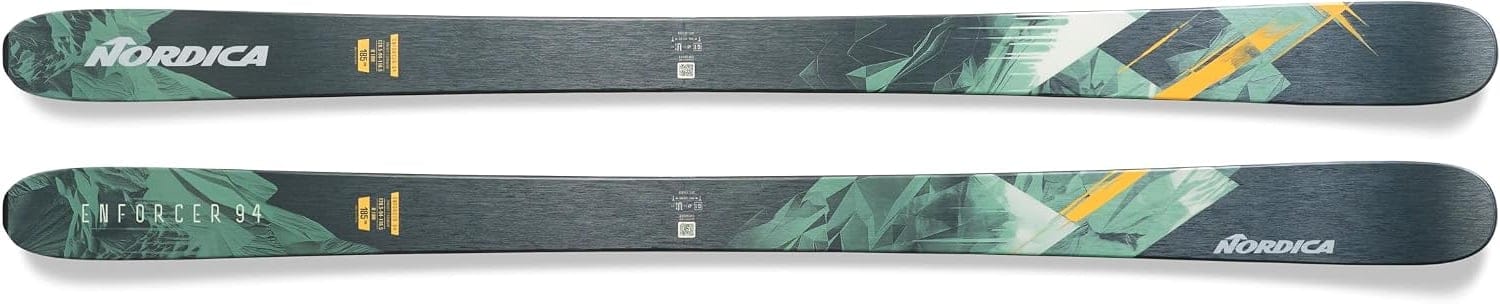 | 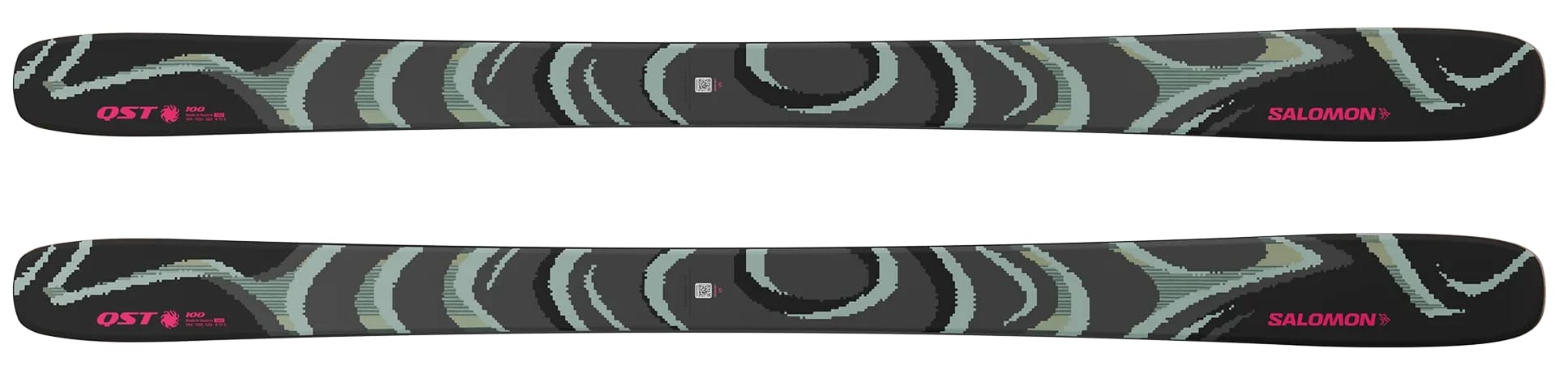 VS | |
| Waist Width | 94 mm | 100 mm |
| Turn Radius | 18 m at 185 cm | 17.5 m at 180 cm |
| Rocker Profile | All Mountain rocker with Unlocked Tail shape | Freeride profile (17% tip rocker, camber, 21% tail rocker) |
| Metal Layers | 2 (Titanal) | 1 (Ti Binding Reinforcement underfoot) |
| Length Range | 167-185 cm | 148-188 cm |
| Weight | 9.4 lb per pair at 185 cm | 4.1 lb per ski at 180 cm |
| Warranty | N/A | 2 Years |
| Sidecut Dimensions | 128.5-94-116.5 mm | 134-100-122 mm |
| Core Material | Performance wood core with Pulse elastomer core | Full poplar woodcore |
| Sidewall | Sidewall construction | Full sandwich |
| Nordica Enforcer 94 | Salomon QST 100 |
|---|---|
| |
| Waist Width | |
94 mm | 100 mm |
| Turn Radius | |
18 m at 185 cm | 17.5 m at 180 cm |
| Rocker Profile | |
All Mountain rocker with Unlocked Tail shape | Freeride profile (17% tip rocker, camber, 21% tail rocker) |
| Metal Layers | |
2 (Titanal) | 1 (Ti Binding Reinforcement underfoot) |
| Length Range | |
167-185 cm | 148-188 cm |
| Weight | |
9.4 lb per pair at 185 cm | 4.1 lb per ski at 180 cm |
| Warranty | |
N/A | 2 Years |
| Sidecut Dimensions | |
128.5-94-116.5 mm | 134-100-122 mm |
| Core Material | |
Performance wood core with Pulse elastomer core | Full poplar woodcore |
| Sidewall | |
Sidewall construction | Full sandwich |
Stability
Enforcer 94
QST 100
Stability matters for all-mountain skis because it determines how calm a ski feels at speed, on chattery snow, and when the surface changes beneath you. The Enforcer 94 is built around this strength, with buyers repeatedly describing it as rock solid, damped, and unflinching at speed, and it soaks up chatter well. The QST 100 matches that calm with basalt stringers and cork dampeners in the tip and tail, and buyers say it stays stable at high speed and tracks true thanks to its sturdier tail. Both score strongly, but the QST 100 edges ahead in overall feedback and feels more composed across mixed conditions. Its main weakness is chatter on pure ice, which the Enforcer's stiff, damped build handles better on the rare days when ice is the norm. Skiers who want the most planted, aggressive speed feel may still lean toward the Enforcer, but for most buyers the QST 100 is the more composed choice.
Edge Grip
Enforcer 94
QST 100
Edge grip determines how confidently a ski holds a carve on groomers and firm snow. The Enforcer 94 earns strong praise for carving well, eating firm snow, and holding up through long GS and super G style turns, with buyers calling it very confident on edge. Its narrower waist helps it hold on icy spots, and it gives more bite entering a turn than the wider 99. The QST 100 is rated just as highly, with buyers describing it as an extraordinarily good carving ski whose camber section feels locked in on groomers. Its taper shape lets it hook just enough to carve while still pulling through the finish without feeling overly hooky. Feedback on the QST 100 is consistently positive on this point, while the Enforcer's grip is praised but comes with a stiffer, more demanding feel. Committed carvers may appreciate the Enforcer, but the QST 100 is the better bet for buyers who want satisfying, precise carving across more conditions.
Maneuverability
Enforcer 94
QST 100
Maneuverability decides how easily a ski turns in short radius turns, bumps, and trees. The Enforcer 94 is praised for its responsiveness, being quicker than the wider 99, with pop and snap from its positive camber and surprising quickness in moguls for such a stiff, heavy ski. Buyers also report that it is heavy, requires hard work, can be harder to control when skiers are mellow, and struggles with short, quick turns. The QST 100 is a clear step ahead, with buyers calling it very easy to steer through trees and tight spaces, quick to initiate turns, and off the charts in maneuverability thanks to its lighter weight and rocker tip and tail. It pops out of bumps and makes S-turns and tight corners feel effortless, though a few note it is still a little wiggly on flat base. For most skiers who like to pivot, play, and weave, the QST 100 is far easier to work with.
Forgiveness
Enforcer 94
QST 100
Forgiveness matters for skiers who are not always precise, because it determines how much a ski helps recover from mistakes. The Enforcer 94 is held back by buyers describing it as demanding, with a pretty stiff flex that needs speed to bend and requires attention in every situation. Some say the shape is forgiving enough and the ski still comes around after mistakes, but the negative feedback outweighs the praise. The QST 100 has softer tips and tails that make it more forgiving, and buyers say it is easy to get back in control and almost finishes the turn for you. It also absorbs terrain changes well and is amenable to correcting mistakes. Some feedback notes it is less approachable than the QST 98 and can be off-putting to true beginners, so it is not a beginner ski, but it is clearly the more forgiving and easier-to-use option of the two.
Powder Performance
Enforcer 94
QST 100
Powder performance matters because an all-mountain ski still needs to handle new snow and deep days. The Enforcer 94 is only a middling performer here, with buyers split and noting it is not a great deep snow ski and feels a little narrow at 94 mm. It is fine on occasional soft snow but is not designed to lead in deep conditions. The QST 100 is much stronger, with buyers saying it floats incredibly well, never lacks flotation, and handles deeper areas with ease thanks to its broader tip and rocker. Buyers also say it floats better than the QST 98 at speed and feels especially good in trees with fresh snow. For skiers who regularly face powder, the QST 100 is the clear choice, while the Enforcer is a neutral factor for anyone who sees mostly groomed or firm terrain.
Versatility
Enforcer 94
QST 100
Versatility is about how many jobs one ski can do across terrain, snow types, and skier levels. The Enforcer 94 is respected as a capable all-mountain ski that handles soft snow, moguls, trees, and skier cross, and some buyers say it can ski any turn in any condition. However, others find it one-dimensional, not well suited to moguls or tree skiing, and not a great park ski, and some feel it does not inspire creativity. The QST 100 has a much broader reputation, with buyers describing it as well-rounded and capable across nearly all conditions except pure blue ice. It works for many abilities, handles trails, crud, bumps, trees, groomers, and jumps, and its tail rise allows some freestyle fun. Its limitations are mostly for dedicated park use. For a single ski that handles nearly everything, the QST 100 is the stronger choice.
Trust & Transparency
- Data-driven rankings from real user reviews
- Affiliate partnerships don't influence our methodology
We may earn commission from links.
Conclusion & Final Verdict:
Choose the Salomon QST 100 if you want one ski that handles groomers, trees, bumps, and fresh snow with ease, you want a more forgiving feel, or you are looking for the stronger overall value with a 2-year warranty. It wins in every category we compared, especially maneuverability, powder, and versatility.
Choose the Nordica Enforcer 94 if you are a strong, speed-focused skier who prefers a stiff, damped ski for firm snow and aggressive carving, and you are comfortable with a demanding, heavier feel. It is a capable carver, but it is less forgiving and less versatile for most skiers.
Related Comparisons
Nordica Enforcer 94vsLINE Pandora 99
The Enforcer 94 suits aggressive, speed-driven skiers who want damp, locked-in stability and strong edge grip on groomers and firm snow. The Pandora 99 is the better pick for playful skiers who prioritize agility, float in soft snow, and twin-tip versatility over high-speed composure.
Nordica Enforcer 94vsNordica Santa Ana 92
The Enforcer 94 is the stiffer, more stable carver for strong skiers who drive hard on groomers and firm snow, while the Santa Ana 92 is the more forgiving, versatile daily driver for advanced skiers who want quicker turns in bumps and trees. Choose the Enforcer for high-speed grip and composure, or the Santa Ana for easier all-round performance.
Nordica Enforcer 94vsRossignol Sender 100
The Nordica Enforcer 94 suits aggressive skiers who want damped, locked-in stability and carving grip at speed, while the Rossignol Sender 100 is the more agile, forgiving and versatile choice for mixed resort skiing, bumps, trees and park laps.
Nordica Enforcer 94vsStöckli Stormrider 88
The Nordica Enforcer 94 is a stiff, powerful carver that rewards a strong, fast skier with composed stability and bite, while the Stöckli Stormrider 88 is the more approachable and versatile all-mountain choice for most skiers who want easy, forgiving performance across varied snow.
Nordica Enforcer 94vsVölkl M7 Mantra
The Enforcer 94 suits aggressive skiers who want a damped, stable ski that carves hard on groomers and firm snow. The M7 Mantra is the better one-ski choice for strong skiers who want more edge hold, quicker turns, and wider conditions range.
Nordica Santa Ana 92vsSalomon QST 100
The Santa Ana 92 is the more damped, forgiving choice for advanced skiers who want a quick, planted daily driver. The QST 100 is the better pick for all-mountain skiers who want stronger carving, float, and turning ease across the whole mountain.