
Backcountry Access Tracker 3+ vs PIEPS Pro IPS
Why You Can Trust Us
- Side-by-side analysis based on real user feedback
- Unbiased comparisons, not influenced by partnerships
- Updated as new data becomes available
We may earn from affiliate links at no extra cost to you.
| Tracker 3+ | Pro IPS | |
|---|---|---|
 |  VS | |
| Antenna Count | 3 | 3 |
| Range | 164 ft (50 m max range) | 230 ft (70 m max range) |
| Multiple Burial Marking | Yes (signal suppression) | Yes |
| Weight | 5.8 oz (164 g, without harness) | 7.5 oz (212 g, with batteries) |
| Battery Life | ≈250 hr send | ≈50 hr search | ≥600 hr send (alkaline) | ≥800 hr (lithium) |
| Warranty | 5 years (limited) | 2 years; 5 years with app registration |
| Frequency | 457 kHz | 457 kHz |
| Auto Revert Timer | Yes (motion-sensing) | Yes (secondary-avalanche switchover) |
| Battery Type | 3 × AAA alkaline | 3 × AAA (alkaline or lithium) |
| Bluetooth | No | Yes |
| Dimensions | 4.57 × 2.80 × 0.91 in | 4.72 × 2.95 × 0.94 in |
| Backcountry Access Tracker 3+ | PIEPS Pro IPS |
|---|---|
| |
| Antenna Count | |
3 | 3 |
| Range | |
164 ft (50 m max range) | 230 ft (70 m max range) |
| Multiple Burial Marking | |
Yes (signal suppression) | Yes |
| Weight | |
5.8 oz (164 g, without harness) | 7.5 oz (212 g, with batteries) |
| Battery Life | |
≈250 hr send | ≈50 hr search | ≥600 hr send (alkaline) | ≥800 hr (lithium) |
| Warranty | |
5 years (limited) | 2 years; 5 years with app registration |
| Frequency | |
457 kHz | 457 kHz |
| Auto Revert Timer | |
Yes (motion-sensing) | Yes (secondary-avalanche switchover) |
| Battery Type | |
3 × AAA alkaline | 3 × AAA (alkaline or lithium) |
| Bluetooth | |
No | Yes |
| Dimensions | |
4.57 × 2.80 × 0.91 in | 4.72 × 2.95 × 0.94 in |
Accuracy
Tracker 3+
Pro IPS
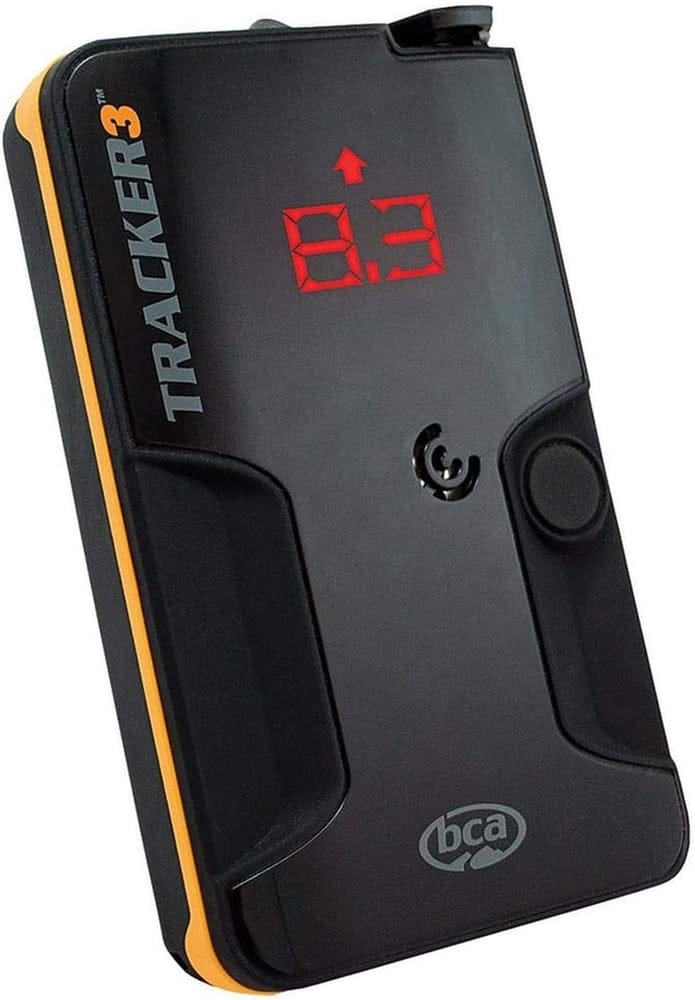
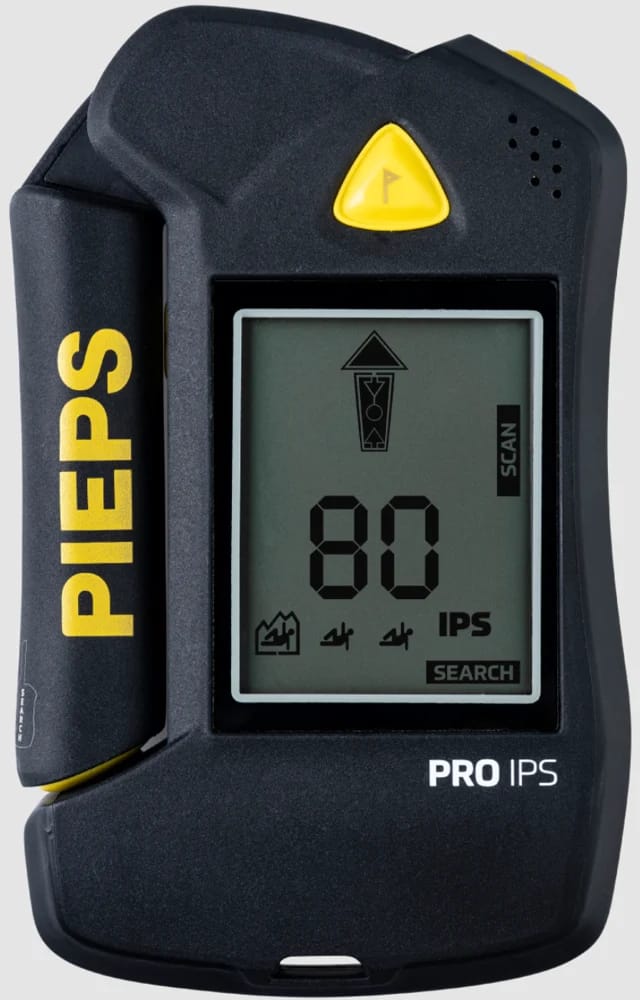
Accuracy matters because a beacon has to guide you to a burial quickly and help you separate multiple signals when time is short. The Tracker 3+ gives buyers clear approximate distance and direction to a buried transceiver, with readings reported around 43 to 45 meters and 20 meters in buyer feedback. Its pinpointing lock-on helps sort out the closest victim when several beacons are close together, which is valuable in multi-burial scenarios. The Pro IPS is guided directly to a buried transmitter even from a considerable distance, and off-course movements are corrected by its small arrow. However, buyer feedback is split because one reading showed 61 meters when the true distance was about 40 meters, so distance readouts can overstate how far away a transmitter is. For most buyers, the Tracker 3+ is the more dependable choice for narrowing in on a burial, though very tight multi-burial situations still call for careful search technique with either unit.
Durability
Tracker 3+
Pro IPS
Durability matters because a beacon is carried in harsh cold, wet snow, and rough handling over many seasons. Buyer feedback for both the Tracker 3+ and the Pro IPS does not provide enough detailed commentary to call either one a standout or a weak point. Both land at a middle score, so neither product gets a clear edge here. Buyers who expect rough treatment should look for independent long-term test reports and check the warranty terms, rather than relying on this category alone. In this comparison, durability is effectively a tie.
Ease Of Use
Tracker 3+
Pro IPS
Ease of use matters because a beacon has to be switched and operated correctly under pressure, often by someone who is stressed or cold. The Tracker 3+ is one of the most praised options for simple operation, with a basic startup, a safety slide and dial turn, a follow-the-arrow search process, and a quick switch back to transmit mode that reviewers find easy to learn. Some users note that the auto revert to transmit must be set at each startup, which is a minor step to remember. The Pro IPS received more criticism in this area, with buyers reporting that it was unclear which button to press and that some button presses did nothing, leading some to read the manual after the auto revert. For buyers who want straightforward controls with little to memorize, the Tracker 3+ is the clear choice, while Pro IPS owners should plan to study the manual before heading out.
Field Reliability
Tracker 3+
Pro IPS
Field reliability matters because a beacon has to perform consistently in real conditions, not just on a test bench. The Pro IPS is the standout here, with buyers describing its range as noticeably longer in the field, its lock-on to transceivers as reliable, and its overall performance as solid. Buyers also reported that they trusted the device at about 50 meters in the field and expected no problems with the transceiver. The Tracker 3+ has a 50 meter range that some buyers praise as strong for a transceiver, but others raised concerns about how it handles double burial indication. Buyers who rely on consistent results in cold, wet, or long-duration trips should weigh these cautions carefully. For most buyers prioritizing dependable performance in the field, the Pro IPS is the more persuasive option.
Signal Clarity
Tracker 3+
Pro IPS
Signal clarity matters because a clear display and audio cue help you understand what the beacon is telling you when you are searching in a hurry. The Tracker 3+ earns strong praise for a multiple-signal icon and bracket when victims are within about 6 meters, signal suppression that locks onto the second strongest signal, and Big Picture Mode that shows two separate signals at once. Its audio tones change with distance, and its single number and arrow display is easy to read without busy graphics, although a few reviewers found the cluttered graphics on competing beacons confusing. The Pro IPS is praised for detecting interfered transceivers earlier and for amplifying its transmit signal above interference, and a longer antenna is said to reduce screen interference. Buyers still note some complaints, but the Pro IPS offers a meaningful advantage in transmit strength. Overall, the Tracker 3+ gives the clearer display experience, while the Pro IPS offers stronger signal penetration through interference.
Comfort
Tracker 3+
Pro IPS
Comfort matters because a beacon is worn for hours on long tours, and a lighter, slimmer unit is easier to carry and less intrusive under layers. The Tracker 3+ is noticeably lighter and smaller than many earlier models, with reviewers highlighting its 20 percent weight and size reduction and its sleek, low-profile design that suits a pocket. Comfort on the body still depends on how the included harness fits each user. Buyer feedback for the Pro IPS does not give enough detail to call its comfort a standout strength or a drawback, so it sits at a middle score. For buyers who expect long days carrying the beacon, the Tracker 3+ has the clearer advantage on comfort.
Trust & Transparency
- Data-driven rankings from real user reviews
- Affiliate partnerships don't influence our methodology
We may earn commission from links.
Conclusion & Final Verdict:
The Tracker 3+ is the better overall pick for most backcountry skiers. It wins on ease of use, signal clarity, accuracy, comfort, and compact size, and it offers a simple operation that reviewers find easy to learn under pressure.
Choose the Pro IPS if field range and battery life matter most. It earns the strongest praise for field reliability, offers a longer 70 meter range, and provides far longer transmit runtime and lithium battery support. Be prepared to study the manual because the button layout can be confusing.
Related Comparisons
Backcountry Access Tracker 3+vsBackcountry Access Tracker 4
The Tracker 3+ leads on signal clarity, accuracy, and simple operation, making it the better pick for fast, clear searches. The Tracker 4 is the tougher choice for buyers who are hard on their gear and want a larger, brighter countdown display.
Backcountry Access Tracker 3+vsBlack Diamond Guide BT
The Tracker 3+ is the simpler, cleaner choice for buyers who want fast startup, clear signal display, and a slimmer unit for long tours. The Guide BT suits buyers who want Bluetooth app settings, water resistance, and better field stability, provided they confirm recall status and are willing to train on its analog mode.
Backcountry Access Tracker 3+vsMammut Barryvox 2
The Tracker 3+ is the stronger pick for buyers who want clearer signal display, simpler startup and better multi-victim guidance. The Barryvox 2 suits those who prioritize longer send-mode battery life, a 70 m range and a slightly more compact feel.
Backcountry Access Tracker 3+vsMammut Barryvox S2
The Barryvox S2 is the better choice for most buyers who value field reliability, Bluetooth settings, voice-guided searching, and a slimmer, longer-running unit. The Tracker 3+ suits buyers who want its clear multi-signal display and simple controls and can accept weaker reliability feedback.
Backcountry Access Tracker 3+vsOrtovox Diract Voice
The Tracker 3+ is the better pick for buyers who put search accuracy, clear signal display and battery endurance first, with simple operation and a slim pocket-friendly build. The Diract Voice suits buyers who want spoken direction prompts, steadier field performance and a more comfortable carry, while accepting less precise distance readings in multi-victim searches.
Backcountry Access Tracker 3+vsOrtovox Focus Voice
The Tracker 3+ is the better pick for buyers who want the clearest visual signal display, pinpointing lock-on, and a lighter unit, while the Focus Voice suits those who want spoken search guidance and stronger field reliability features. Both are capable beacons, so choose based on whether you value visual clarity or voice-led searching.