
Backcountry Access Tracker S vs Black Diamond Guide BT
Why You Can Trust Us
- Side-by-side analysis based on real user feedback
- Unbiased comparisons, not influenced by partnerships
- Updated as new data becomes available
We may earn from affiliate links at no extra cost to you.
| Tracker S | Guide BT | |
|---|---|---|
 |  VS | |
| Antenna Count | 3 | 3 |
| Range | 164 ft (50 m max range) | 197 ft (60 m max range) |
| Multiple Burial Marking | Yes (signal suppression) | Yes |
| Weight | 5.5 oz (156 g, without harness) | 7.9 oz (225 g, with batteries) |
| Battery Life | ≈250 hr send | ≈50 hr search | ≈400 hr send (alkaline) | ≈600 hr (lithium) |
| Warranty | 5 years (limited) | 2 years; 5 years with registration |
| Frequency | 457 kHz | 457 kHz |
| Auto Revert Timer | Yes | Yes |
| Battery Type | 3 × AAA alkaline | 3 × AAA (alkaline or lithium) |
| Bluetooth | No | Yes |
| Dimensions | 4.80 × 2.91 × 1.02 in | 4.53 × 2.95 × 1.10 in |
| Backcountry Access Tracker S | Black Diamond Guide BT |
|---|---|
| |
| Antenna Count | |
3 | 3 |
| Range | |
164 ft (50 m max range) | 197 ft (60 m max range) |
| Multiple Burial Marking | |
Yes (signal suppression) | Yes |
| Weight | |
5.5 oz (156 g, without harness) | 7.9 oz (225 g, with batteries) |
| Battery Life | |
≈250 hr send | ≈50 hr search | ≈400 hr send (alkaline) | ≈600 hr (lithium) |
| Warranty | |
5 years (limited) | 2 years; 5 years with registration |
| Frequency | |
457 kHz | 457 kHz |
| Auto Revert Timer | |
Yes | Yes |
| Battery Type | |
3 × AAA alkaline | 3 × AAA (alkaline or lithium) |
| Bluetooth | |
No | Yes |
| Dimensions | |
4.80 × 2.91 × 1.02 in | 4.53 × 2.95 × 1.10 in |
Accuracy
Tracker S
Guide BT
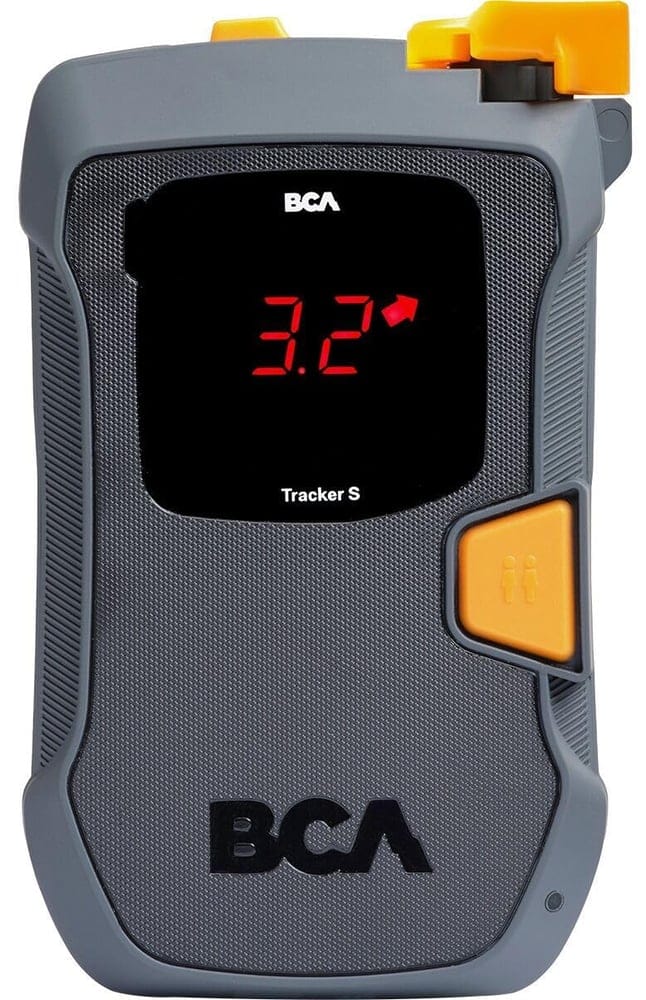
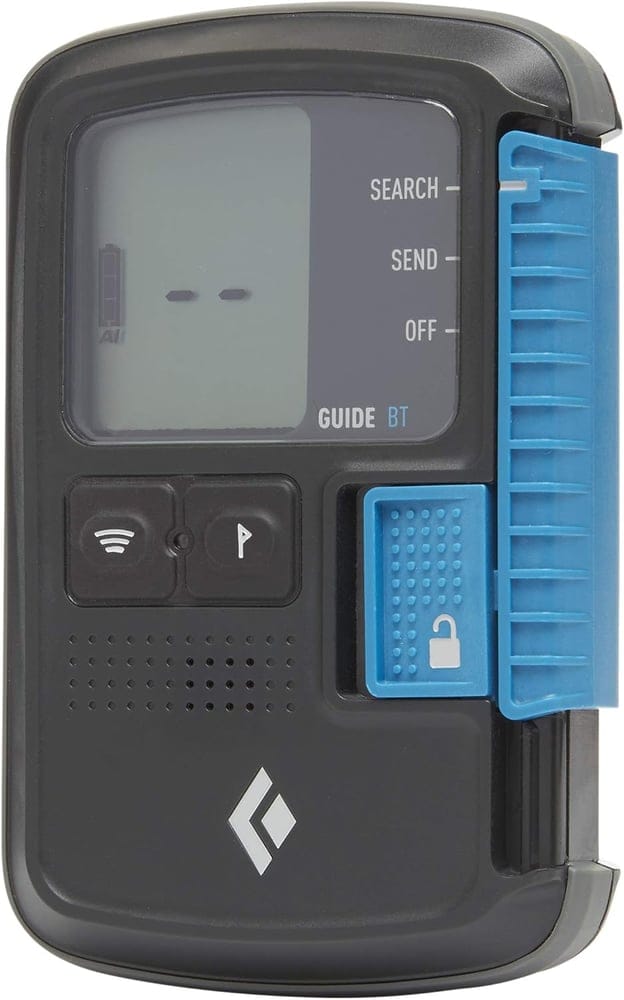
Accuracy matters because a beacon is only useful if its distance and direction readings lead you quickly to a buried transceiver, especially when several victims are involved. Buyers find the Tracker S directional and distance readings straightforward and effective for guiding you to a buried beacon. Some buyers feel it is not as quick or precise as triple-antenna designs, and feedback is thinner on complex multi-victim pinpointing. The Guide BT earns a slight edge here, with buyers describing its GPS-referenced distance readings as accurate and close to real distances, including a 36 m reading that matched expectations. Some users noticed a 19 m reading that was off from an actual 15 m, and a small overestimate at longer range, so it is best to leave a small margin of error during multi-victim recoveries. For most buyers, the Guide BT is the more precise tool, while the Tracker S is adequate for simpler single-victim searches.
Durability
Tracker S
Guide BT
Durability determines whether a beacon survives the bumps, drops, and wet conditions of a real tour, and a beacon that fails in the field is a serious safety problem. Buyers describe the Tracker S as sturdy and able to handle the knocks of backcountry travel, although feedback on long-term toughness is still limited. The Guide BT offers built-in water resistance in both of its models, which is a practical advantage on wet, snowy days when moisture can get into gear. Buyers have less feedback on how the Guide BT holds up to repeated drops and impacts over time. Both beacons are rated at the same durability level, so the decision should rest on your conditions: choose the Guide BT if wet weather is a regular concern, and the Tracker S if you want a compact, well-regarded build for general travel.
Ease Of Use
Tracker S
Guide BT
Ease of use matters most for newer backcountry users, because a confusing beacon is harder to operate under the stress of a real search. The Tracker S is one of the simplest beacons in its class, with buyers calling the interface very user-friendly, intuitive, and free of unnecessary features. Its compact, lightweight body fits comfortably in the hand and does not feel bulky in a pack. The Guide BT is also easy to set up, with buyers praising its app-based settings, the Fleet manager app, and Bluetooth updates for the beacon hardware. Directional arrow guidance and a mark function help during a search, but the analog mode is more advanced and requires practice before you rely on it on a tour. The Tracker S is the better choice for a quick learning curve, while the Guide BT rewards buyers willing to spend time with the app and training.
Field Reliability
Tracker S
Guide BT
Field reliability is what keeps a beacon working across long days, changing conditions, and interference from nearby transceivers. Buyers report excellent performance and reliability overall for the Tracker S, although feedback on extended cold, wet, or long-duration trips is still limited. The Guide BT has a smart antenna system that switches to the other antenna when interference is detected, which helps it stay functional in tricky conditions. Its scan mode widens tolerance for broader detection, but that can shorten effective range, so buyers should expect a tradeoff. The Guide BT also carries a 2022 CPSC recall covering some Black Diamond and PIEPS beacons because some units could not switch from SEND to SEARCH. Any Guide BT, especially a used one, should be confirmed as inspected or replaced under that recall before you rely on it. The Tracker S has the cleaner reliability record in the evidence, so it is the more dependable pick for buyers who want less uncertainty.
Signal Clarity
Tracker S
Guide BT
Signal clarity affects how easily you can read signal strength and direction on the display, which is critical when you are trying to narrow down a buried beacon in a hurry. Buyers find the Tracker S display clear and easy to read, even in bright sunlight, though some report signal fluctuations or spikes in challenging terrain. The Guide BT scan mode groups nearby signals by distance bands, giving a clearer overall picture of several transceivers, and its three circular antennas support reception. Some users, however, report weak or intermittent signals and shifting numbers that can cause confusion. Both beacons have mixed feedback in this category, so neither has a clear edge. The Tracker S is simpler to read at a glance, while the Guide BT offers a more structured view of multiple signals if you practice with it first.
Comfort
Tracker S
Guide BT
Comfort matters because a beacon that is light and easy to carry is more likely to be worn consistently on long tours. Buyer feedback for both beacons does not give enough detail to call either one a standout benefit or a major drawback, so both land at the same rating. The Tracker S has a compact, lightweight body that sits comfortably in the hand and adds little bulk to a pack, which is a real comfort advantage. The Guide BT is heavier and slightly thicker in some dimensions, which may matter more for lightweight touring. Since the evidence does not separate the two clearly, the choice should depend on how much you value a lighter pack and whether you need the Guide BT features.
Trust & Transparency
- Data-driven rankings from real user reviews
- Affiliate partnerships don't influence our methodology
We may earn commission from links.
Conclusion & Final Verdict:
Choose the Tracker S if you are newer to avalanche rescue and want the simplest possible beacon with an intuitive interface, a lightweight body, and strong field reliability in the evidence. Choose the Guide BT if you want longer range, the more precise distance readings, a wider battery choice including lithium, Bluetooth app settings, and built-in water resistance, and you are willing to invest time in training and confirm your unit is covered by the CPSC recall inspection. Both beacons earn the same overall rating, so the practical decision comes down to whether you value simplicity and reliability or advanced features and range.
Related Comparisons
Backcountry Access Tracker SvsMammut Barryvox S2
The Barryvox S2 is the stronger all-round transceiver, with clearer guidance, Bluetooth settings, longer range, and better signal clarity. The Tracker S suits beginners who want a simpler, lighter beacon with fewer features to learn.
Backcountry Access Tracker SvsPIEPS Pro IPS
The Backcountry Access Tracker S suits beginners who want a simple, compact beacon with an easy-to-learn interface. The PIEPS Pro IPS is the better choice for experienced users who prioritize field range, lock-on, and longer battery life, and can accept less intuitive buttons.
Mammut Barryvox 2vsBlack Diamond Guide BT
The Barryvox 2 is the simpler, lighter choice for teaching new partners and for touring with a slim pocket-friendly unit. The Guide BT suits buyers who want app-based settings, water resistance and directional guidance and are willing to practice its analog mode.
Mammut Barryvox S2vsBlack Diamond Guide BT
The Barryvox S2 is the better choice for buyers who want voice-guided, glove-friendly searching and a lighter, slimmer carry. The Guide BT suits those who prefer app-based setup, built-in water resistance, and a scan mode that groups signals by distance.
Ortovox Diract VoicevsBlack Diamond Guide BT
The Diract Voice is the easier, more pocket-friendly choice for searchers who want spoken direction and a simple one-hand setup with gloves on. The Guide BT suits buyers who want app-based settings, slightly better distance readings, built-in water resistance and much longer battery life.
Mammut Barryvox 2vsPIEPS Pro IPS
The Barryvox 2 is the easier beacon for new partners and anyone who wants a lighter, smaller unit with simple operation. The Pro IPS suits experienced users who prioritize stronger lock-on in the field and longer battery life, provided they are willing to learn its less intuitive buttons.