
Backcountry Access Tracker S vs PIEPS Pro IPS
Why You Can Trust Us
- Side-by-side analysis based on real user feedback
- Unbiased comparisons, not influenced by partnerships
- Updated as new data becomes available
We may earn from affiliate links at no extra cost to you.
| Tracker S | Pro IPS | |
|---|---|---|
 |  VS | |
| Antenna Count | 3 | 3 |
| Range | 164 ft (50 m max range) | 230 ft (70 m max range) |
| Multiple Burial Marking | Yes (signal suppression) | Yes |
| Weight | 5.5 oz (156 g, without harness) | 7.5 oz (212 g, with batteries) |
| Battery Life | ≈250 hr send | ≈50 hr search | ≥600 hr send (alkaline) | ≥800 hr (lithium) |
| Warranty | 5 years (limited) | 2 years; 5 years with app registration |
| Frequency | 457 kHz | 457 kHz |
| Auto Revert Timer | Yes | Yes (secondary-avalanche switchover) |
| Battery Type | 3 × AAA alkaline | 3 × AAA (alkaline or lithium) |
| Bluetooth | No | Yes |
| Dimensions | 4.80 × 2.91 × 1.02 in | 4.72 × 2.95 × 0.94 in |
| Backcountry Access Tracker S | PIEPS Pro IPS |
|---|---|
| |
| Antenna Count | |
3 | 3 |
| Range | |
164 ft (50 m max range) | 230 ft (70 m max range) |
| Multiple Burial Marking | |
Yes (signal suppression) | Yes |
| Weight | |
5.5 oz (156 g, without harness) | 7.5 oz (212 g, with batteries) |
| Battery Life | |
≈250 hr send | ≈50 hr search | ≥600 hr send (alkaline) | ≥800 hr (lithium) |
| Warranty | |
5 years (limited) | 2 years; 5 years with app registration |
| Frequency | |
457 kHz | 457 kHz |
| Auto Revert Timer | |
Yes | Yes (secondary-avalanche switchover) |
| Battery Type | |
3 × AAA alkaline | 3 × AAA (alkaline or lithium) |
| Bluetooth | |
No | Yes |
| Dimensions | |
4.80 × 2.91 × 1.02 in | 4.72 × 2.95 × 0.94 in |
Accuracy
Tracker S
Pro IPS
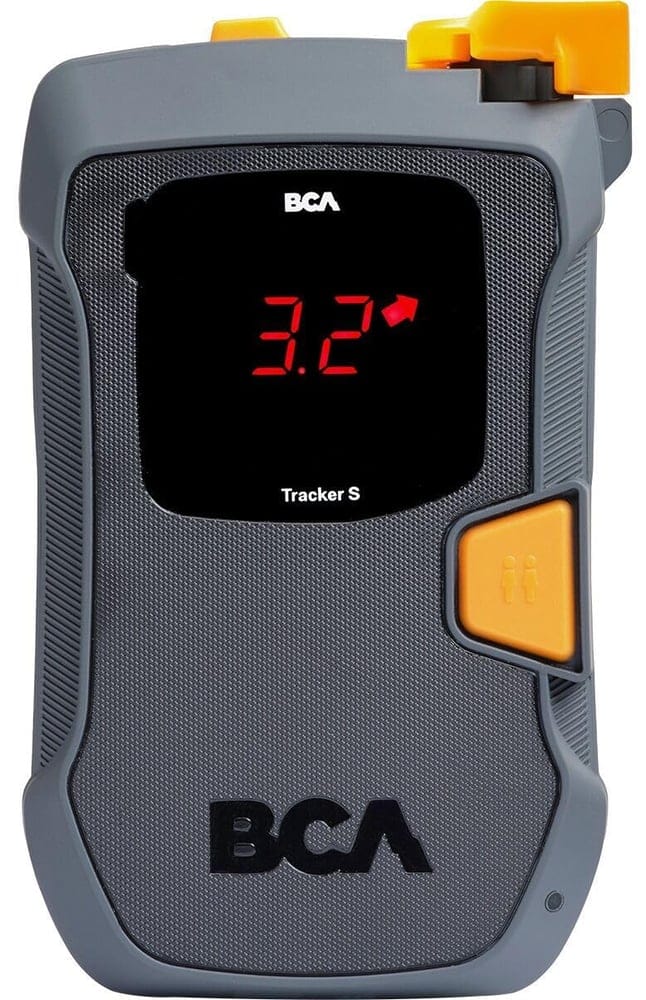
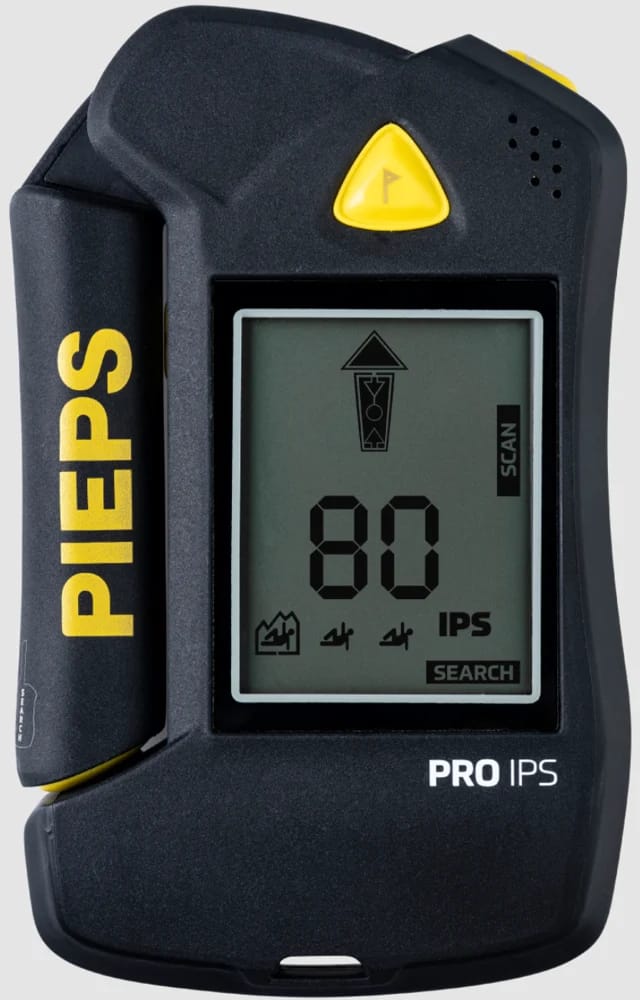
Accuracy matters because a beacon is only useful if its directional and distance readings guide you quickly to a buried transmitter. Buyers say the Tracker S gives straightforward directional and distance readings that lead effectively to a buried beacon, which makes it dependable for standard single-burial searches. Some feedback notes that its single antenna is less fast and precise than triple-antenna models when pinpointing complex multi-victim scenarios. The Pro IPS gets mixed reviews: some buyers report it guides them directly to a transmitter from great distance, and that off-course attempts are corrected by a small arrow, but others found its distance readout overstated the true distance, with one reading of 61 m against about 40 m actual. For a buyer, both beacons guide you to a buried signal, but neither is clearly more precise, so the verdict is a tie with different trade-offs in readout behavior.
Durability
Tracker S
Pro IPS
Durability matters because backcountry beacons get knocked around in packs, on snow, and during bumpy travel. Buyers describe the Tracker S as sturdy enough to handle the bumps and knocks of backcountry trips, which is a genuine plus for a compact device. Feedback on long-term durability is still limited, so shoppers should not assume it has the track record of more established beacons. The Pro IPS has no meaningful durability feedback in the available reviews, which leaves its rating neutral rather than a demonstrated strength or weakness. For a buyer, the Tracker S has the clearer positive durability signal, while the Pro IPS remains an unknown that should be weighed against its other strengths.
Ease Of Use
Tracker S
Pro IPS
Ease of use matters because beacon searches happen under stress, and a confusing interface can cost valuable time. The Tracker S is one of its strongest points, with buyers calling the interface very user-friendly and intuitive, and praising its simple, no-frills controls that suit beginners. Its compact, lightweight body fits comfortably in the hand and does not feel bulky in a pack, which supports the same easy-to-use experience. The Pro IPS is held back by complaints that the button layout is unclear, that some presses do nothing, and that at least one buyer had to read the manual after an auto revert. For a buyer, the Tracker S is the far easier beacon to learn, and the Pro IPS is worth reading the manual before a tour.
Field Reliability
Tracker S
Pro IPS
Field reliability matters because a beacon has to perform consistently when it is actually needed, not just in a showroom. Buyers report that the Pro IPS performs solidly overall, locks onto transceivers reliably, and offers a range that feels noticeably longer in the field, with several buyers saying they trust it at around 50 meters. The Tracker S also earns positive reports for excellent performance and reliability overall across field use. However, feedback on extended cold, wet, or long-duration trips is limited for the Tracker S, while the Pro IPS has a much deeper and more consistently positive body of evidence. For a buyer, the Pro IPS is the stronger choice when dependable lock-on and extended range are the priority.
Signal Clarity
Tracker S
Pro IPS
Signal clarity matters because interference from other transceivers and buried debris can make a search slow and confusing. The Tracker S display is clear and easy to read, even in bright sunlight, which helps during the search, but some buyers report signal fluctuations or spiking in challenging terrain. The Pro IPS is praised for detecting interfered transceivers earlier and for amplifying its transmit signal above interference, and buyers note that its longer antenna reduces screen interference. A smaller set of complaints keeps it from being flawless, but the positive signals are more consistent. For a buyer working in complex or interference-heavy terrain, the Pro IPS offers the meaningful advantage, while the Tracker S is a reasonable choice in more open conditions.
Comfort
Tracker S
Pro IPS
Comfort matters because a beacon is worn for long tours and needs to feel manageable when carried or operated in the hand. The Tracker S's compact, lightweight body is praised for fitting comfortably in the hand and for not feeling bulky in a pack, which is one of its clearest physical advantages. The Pro IPS has no specific comfort feedback in the available reviews, so its comfort is neither a highlight nor a drawback. Because the Tracker S comfort story is mostly tied to ease of handling and carrying, while the Pro IPS evidence is missing, the two products are effectively even on this category. For a buyer, the practical takeaway is that the Tracker S is easy to carry, but the Pro IPS shows no clear comfort issue either.
Trust & Transparency
- Data-driven rankings from real user reviews
- Affiliate partnerships don't influence our methodology
We may earn commission from links.
Conclusion & Final Verdict:
Choose the Tracker S if you are newer to backcountry travel, want the easiest beacon to learn, and value a compact, lightweight body that handles bumps well. Choose the PIEPS Pro IPS if you are an experienced user who prioritizes longer field range, reliable lock-on, earlier detection in interference, and much longer send battery life, and you are willing to read the manual to master its button layout.
Related Comparisons
Backcountry Access Tracker 4vsPIEPS Pro IPS
The Tracker 4 suits backcountry users who are hard on their gear, with a rubberized overmold, slim pocket-friendly body and simpler controls. The Pro IPS suits those who prioritize field range, lock-on reliability and long battery life, provided they accept a less intuitive button layout.
Backcountry Access Tracker SvsBackcountry Access Tracker 3+
The Tracker S suits beginners who want the simplest possible beacon with a clear display and strong field reliability, while the Tracker 3+ is the better pick for buyers who need sharper signal handling for multi-victim searches and a motion-sensing auto revert.
Backcountry Access Tracker SvsBlack Diamond Guide BT
The Tracker S suits beginners who want a simple, light beacon with an easy interface, while the Guide BT suits searchers who want Bluetooth app settings, longer range, and lithium battery support and can accept a steeper learning curve and a heavier unit.
Backcountry Access Tracker SvsMammut Barryvox 2
The Barryvox 2 is the better pick for buyers who want longer send-mode battery life, a 70 m range, Bluetooth, and an automatic send-mode switch, while the Tracker S suits beginners who value a simpler, lighter, more durable-feeling unit with a 5-year warranty.
Backcountry Access Tracker SvsMammut Barryvox S2
The Barryvox S2 is the stronger all-round transceiver, with clearer guidance, Bluetooth settings, longer range, and better signal clarity. The Tracker S suits beginners who want a simpler, lighter beacon with fewer features to learn.
Backcountry Access Tracker SvsOrtovox Diract Voice
The Tracker S suits beginners who want the simplest possible beacon in a light, compact package. The Ortovox Diract Voice is the better pick for searchers who want spoken direction prompts and a more comfortable carry, though it needs careful cross-checking in multi-victim searches.