
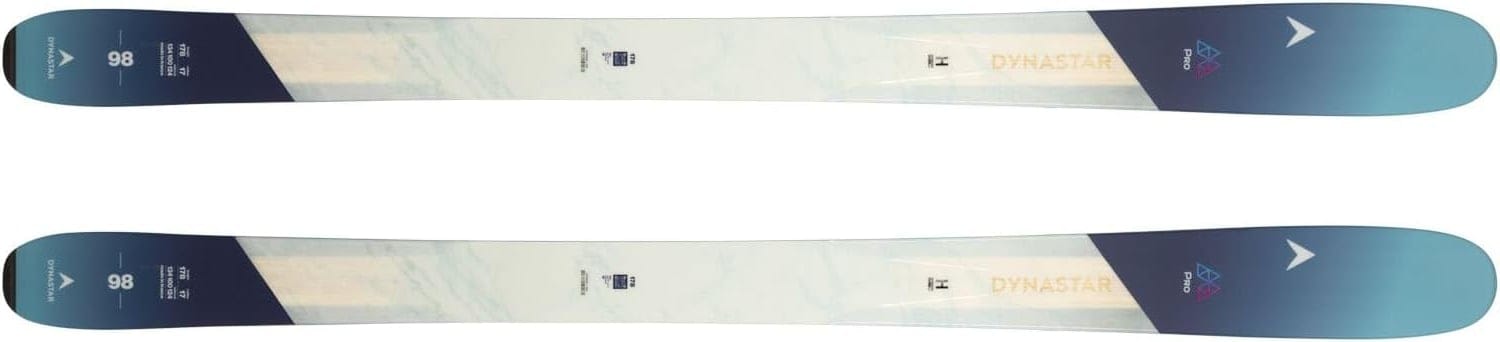
Dynastar M-Pro 98 W vs Blizzard Rustler 9
Why You Can Trust Us
- Side-by-side analysis based on real user feedback
- Unbiased comparisons, not influenced by partnerships
- Updated as new data becomes available
We may earn from affiliate links at no extra cost to you.
| M-Pro 98 W | Rustler 9 | |
|---|---|---|
 |  VS | |
| Waist Width | 98 mm | 96 mm |
| Turn Radius | 15 m at 162 cm | 17 m at 180 cm |
| Rocker Profile | Progressive Rocker (Rocker/Camber/Rocker) | Rockered tip, camber underfoot, rockered tail |
| Metal Layers | Titanal (layer count not specified) | 1 (FluxForm Freeride titanal) |
| Length Range | 154-170 cm | 162-186 cm |
| Weight | N/A | 8.3 lb per pair at 180 cm |
| Warranty | 1 Year | 1 Year |
| Sidecut Dimensions | 133-98-123 mm | 131.5-96-121 mm |
| Core Material | Hybrid Core 2.0 Poplar Tri Directionnal PU | Trueblend Free woodcore (beech, poplar, paulownia) |
| Sidewall | Full sidewall construction | Full ABS |
| Dynastar M-Pro 98 W | Blizzard Rustler 9 |
|---|---|
| |
| Waist Width | |
98 mm | 96 mm |
| Turn Radius | |
15 m at 162 cm | 17 m at 180 cm |
| Rocker Profile | |
Progressive Rocker (Rocker/Camber/Rocker) | Rockered tip, camber underfoot, rockered tail |
| Metal Layers | |
Titanal (layer count not specified) | 1 (FluxForm Freeride titanal) |
| Length Range | |
154-170 cm | 162-186 cm |
| Weight | |
N/A | 8.3 lb per pair at 180 cm |
| Warranty | |
1 Year | 1 Year |
| Sidecut Dimensions | |
133-98-123 mm | 131.5-96-121 mm |
| Core Material | |
Hybrid Core 2.0 Poplar Tri Directionnal PU | Trueblend Free woodcore (beech, poplar, paulownia) |
| Sidewall | |
Full sidewall construction | Full ABS |
Stability
M-Pro 98 W
Rustler 9
Stability matters on all-mountain skis because it determines whether a ski stays calm at speed, through chatter, and in steep or rough terrain. Both skis score well here, but the Dynastar M-Pro 98 W edges ahead at 4.6 versus 4.4. Buyers repeatedly describe the M-Pro as pretty sturdy, with metal and polyurethane sidewalls that damp vibration into a quiet, composed feel, and testers found it stable on steep slopes and predictable in challenging terrain without ever feeling twitchy. The Blizzard Rustler 9 is also described as steady and predictable, with an even flex, good damping, and resistance to washing out or wheelie-ing when skied hard. Its strength shows most when pushed aggressively on groomers, where it stays on line through chatter. For a buyer who skis fast over rough terrain, the M-Pro has a slight edge, but both feel confident, so the difference is modest.
Edge Grip
M-Pro 98 W
Rustler 9
Edge grip determines how well a ski bites and holds a carved turn on firm snow, which matters most for skiers who spend time on groomers. Here the Blizzard Rustler 9 leads, 4.1 to 3.8. Its metal-over-edge build and narrow profile give it a precise, clean carve and a firm hold on hard snow, and buyers describe it as really solid on groomers. The M-Pro 98 W also grips well thanks to its metal underfoot, feels like it wants to be on edge, and holds firm snow without feeling overly aggressive. However, a few buyers wanted more bite through the very end of the turn, and one noted the tail feeling loose on an older pair. So the M-Pro grips well but not flawlessly. If carving firm snow is your priority, the Rustler is the stronger choice, while the difference is manageable if grip is secondary.
Maneuverability
M-Pro 98 W
Rustler 9
Maneuverability shapes how quickly a ski changes direction, how easily it fits into bumps and trees, and how playful it feels in tight terrain. The Dynastar M-Pro 98 W leads clearly here, 4.7 to 4.3. Buyers say it feels more agile than wider skis, swings into turns easily, and pivots with little effort, with shorter swing turns and smooth exits from the turn. Its rocker helps shovel and tail release, and it feels nimble in the trees and easy to maneuver in bumps. The Blizzard Rustler 9 is also playful and quick, with easy tail release, a short-turn feel, and strong performance in bumps, though several buyers noted that sizing up can reduce its quickness and that it can feel skiddy or smeary at times. For skiers who prioritize quick, precise turns in tight terrain, the M-Pro is the better choice, while the Rustler works well at a moderate length.
Forgiveness
M-Pro 98 W
Rustler 9
Forgiveness matters because it determines how well a ski tolerates mistakes and how well it suits developing skiers. Both skis have relatively thin feedback here, and the Blizzard Rustler 9 edges ahead at 3.6 versus 3.2. The Rustler is described as not overpowered for intermediate skiers, which makes it a manageable choice for those still building technique. The M-Pro 98 W's picture is mixed: it never forces a particular turn shape or size, which many buyers appreciate, but it isn't a clear strength and some buyers did not find it especially forgiving. Advanced skiers may find the Rustler more demanding at higher speeds, and developing skiers should weigh that trade-off. Given the limited feedback on both, treat this as a small advantage for the Rustler rather than a decisive one, and consider skill level and length carefully before buying.
Powder Performance
M-Pro 98 W
Rustler 9
Powder performance matters for any all-mountain ski that will see soft snow, since flotation affects how much fun the ski is off-piste. The Dynastar M-Pro 98 W leads clearly, 4.7 to 4.1. Its long rocker makes it a nice floater that stays afloat with a bouncy feel, and buyers describe it as powerful and easy to control in deep snow, with good flotation and fun in the trees. The Blizzard Rustler 9 handles soft snow in a drifty, smearable, playful way, but it is designed as an everyday ski rather than a dedicated powder ski, so it works best as a capable option for occasional powder days. If you regularly ski deep snow, the M-Pro is the clear pick, while the Rustler will still be fun off-piste but won't float as freely.
Versatility
M-Pro 98 W
Rustler 9
Versatility matters for an all-mountain ski because it determines how many conditions and terrain types one pair can handle well. This category is tied at 4.7 for both skis. The Dynastar M-Pro 98 W works across crud, chop, variable snow, and a range of speeds, blending all-mountain and freeride use and suiting skiers who mix conditions. Buyers say it is versatile enough to progress an intermediate skier and that it works especially well in the woods. The Blizzard Rustler 9 is a true one-ski quiver with a twin-tip, all-mountain shape that handles groomers, freeride terrain, park features, and switch skiing, and it is often described as frozen on one side and soft on the other. The two skis cover different parts of the all-mountain spectrum: the M-Pro for variable natural terrain, and the Rustler for ski-anywhere freedom including park and switch riding.
Trust & Transparency
- Data-driven rankings from real user reviews
- Affiliate partnerships don't influence our methodology
We may earn commission from links.
Conclusion & Final Verdict:
Choose the Dynastar M-Pro 98 W if you want a quick, quiet ski that pivots easily in bumps and trees, floats well in soft snow, and stays composed in steep or variable terrain. It is the stronger all-mountain option for mixed conditions with a powder lean.
Choose the Blizzard Rustler 9 if you spend most of your time on firm groomers, want a tight carve with strong edge hold, or want a twin-tip for park laps and switch skiing. It is also the slightly more approachable pick for intermediates who want a manageable ski, provided you size it moderately.
If you are unsure, consider where your days are spent: deep snow and tight terrain point to the M-Pro, while firm snow, park, and switch riding point to the Rustler.
Related Comparisons
Blizzard Rustler 9vsSalomon QST 100
The Blizzard Rustler 9 is a playful twin-tip that suits skiers who want switch riding, park laps, and quick turns in bumps. The Salomon QST 100 is the stronger one-ski quiver for most all-mountain skiers, with better float, damping, and carving.
Blizzard Rustler 9vsStöckli Stormrider 88
The Rustler 9 is the more playful, versatile one-ski quiver for skiers who want quick turns in bumps and tight terrain, plus comfort in softer snow. The Stormrider 88 suits firm-snow carvers who want a quiet, planted ride with more forgiveness and stronger edge hold on ice.
Blizzard Rustler 9vsVölkl M7 Mantra
The Rustler 9 is the more versatile and playful choice for skiers who want one ski for groomers, park, switch, and freeride terrain. The M7 Mantra is a stiffer, high-performance ski with stronger edge grip on ice, best suited to strong, aggressive skiers.
Dynastar M-Pro 98 WvsBlizzard Black Pearl 94
The Dynastar M-Pro 98 W is the better pick for powder, variable snow and quick turns in trees and bumps, while the Blizzard Black Pearl 94 suits intermediate-to-advanced skiers who want firmer edge hold, forgiveness and calm stability at speed.
Dynastar M-Pro 98 WvsElan Ripstick 96 Black Edition
The Dynastar M-Pro 98 W is the more stable, composed all-mountain ski, with stronger powder float and a quieter ride for skiers who want one ski for variable snow. The Elan Ripstick 96 Black Edition is the livelier, more playful option for mobility-focused skiers who prioritize quick turns and touring-friendly versatility.
Dynastar M-Pro 98 WvsHead Kore 94 Ti
The Dynastar M-Pro 98 W is the nimbler, better-floating choice for skiers who want quick turns in bumps, trees and soft snow. The Head Kore 94 Ti suits buyers who put damped stability and all-round versatility first, especially in crud, chop and changing conditions.