
MSR Lightning Explore vs Tubbs Frontier
Why You Can Trust Us
- Side-by-side analysis based on real user feedback
- Unbiased comparisons, not influenced by partnerships
- Updated as new data becomes available
We may earn from affiliate links at no extra cost to you.
| Lightning Explore | Frontier | |
|---|---|---|
 |  VS | |
| Max Load | 22 in: Up to 180 lb | 25 in: 120 - 200 lb |
| Dimensions | 22 in: 22 × 8 in | 25 in, 30 in, 36 in lengths (width not listed) |
| Weight | 22 in: 3 lb 9 oz per pair | 3 lb 14.4 oz per pair (25 in) |
| Binding Type | Paradigm | 180 EZ |
| Crampon Count | Not specified | 2 (recreational toe and heel) |
| Heel Lift | Yes (Ergo Televator) | No |
| Warranty | 3 years limited | 1 year limited |
| Modular Tail Extension | 5 in (sold separately) | No |
| Frame Material | 7075 T6 aluminum frame, TPU-coated nylon deck | Aluminum |
| Bag Included | No | No (optional add-on) |
| MSR Lightning Explore | Tubbs Frontier |
|---|---|
| |
| Max Load | |
22 in: Up to 180 lb | 25 in: 120 - 200 lb |
| Dimensions | |
22 in: 22 × 8 in | 25 in, 30 in, 36 in lengths (width not listed) |
| Weight | |
22 in: 3 lb 9 oz per pair | 3 lb 14.4 oz per pair (25 in) |
| Binding Type | |
Paradigm | 180 EZ |
| Crampon Count | |
Not specified | 2 (recreational toe and heel) |
| Heel Lift | |
Yes (Ergo Televator) | No |
| Warranty | |
3 years limited | 1 year limited |
| Modular Tail Extension | |
5 in (sold separately) | No |
| Frame Material | |
7075 T6 aluminum frame, TPU-coated nylon deck | Aluminum |
| Bag Included | |
No | No (optional add-on) |
Traction
Lightning Explore
Frontier
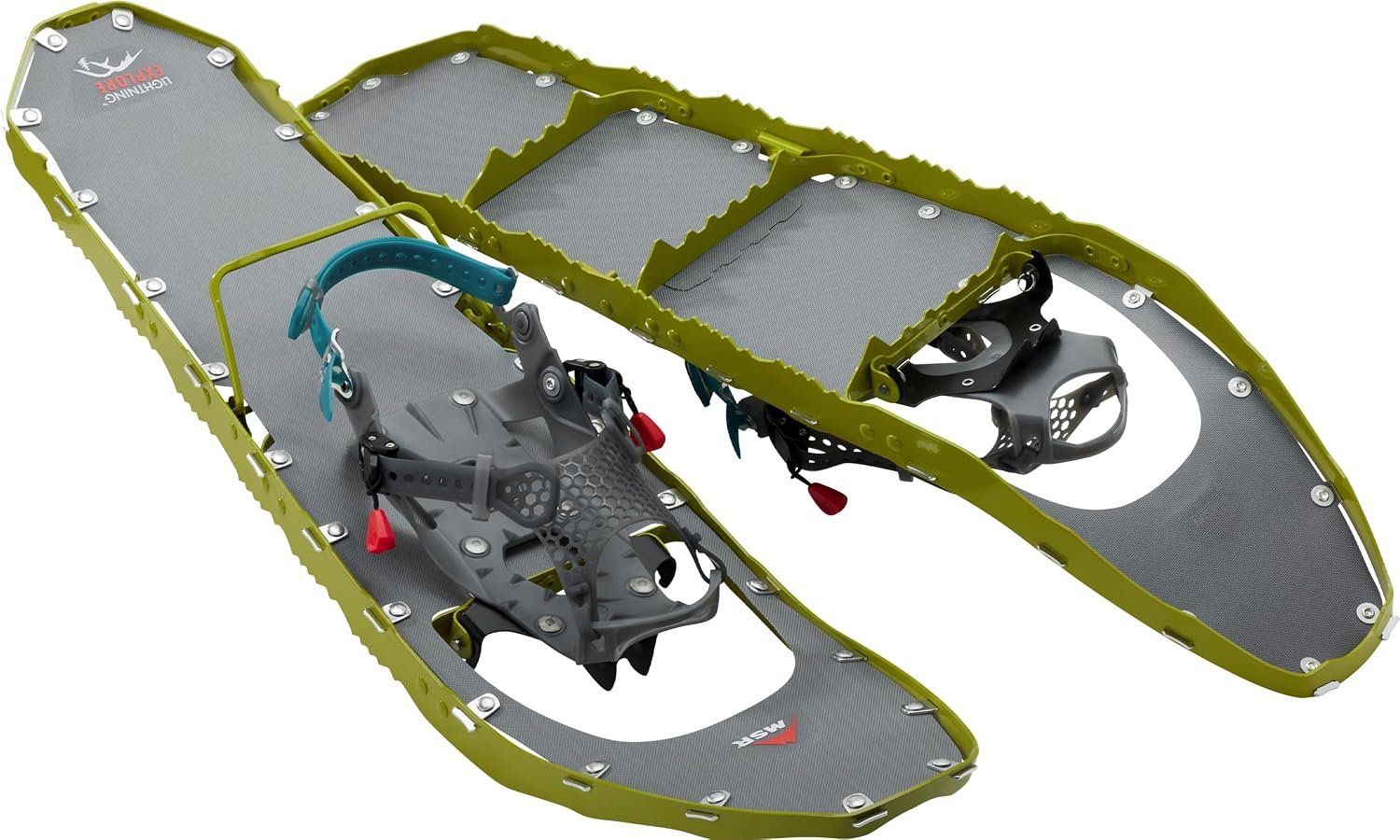
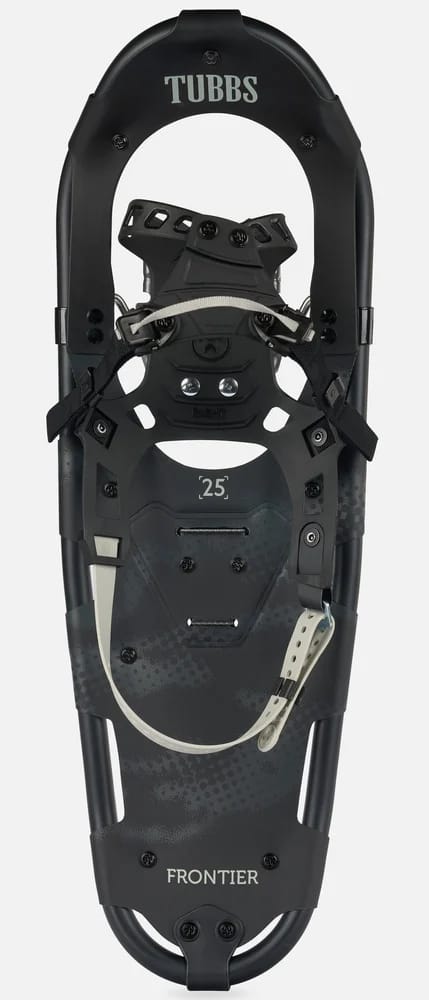
Traction matters because most snowshoe trips involve icy patches, hard-packed trails, and steep climbs where a slip is more than an inconvenience. The Lightning Explore earns its 4.6 out of 5 rating from buyers who describe aggressive perimeter teeth that dig into snow and ice, 360 degrees of grip, brass edges, and serrated edges that bite on uneven ground. Its televator heel lift, step bars, and stabilizer pop-up are repeatedly noted for helping on uphill sections, and some owners say the grip holds up even in brushy or tough terrain. The Frontier also performs well at 4.4 out of 5, with ice cleats on the underside, an angled cleat pattern that digs in when you move forward, and grip under the heel that keeps you from sliding backward on hills. Buyers describe it as working well on slopes, but the Explore has more features aimed at steep and technical climbs. If you regularly tackle ice or steep ascents, the Explore is the stronger choice.
Comfort
Lightning Explore
Frontier
Comfort matters because you may wear snowshoes for many hours, and pressure points or a stiff stride can turn a good day into a tiring one. The Lightning Explore scores 4.6 out of 5, with buyers praising its adjustable binding for all-day wear, a cradle that holds the foot without pressure points, and a rotating design that lets the binding turn about 90 degrees so the stride feels natural. Owners also note that the Explore is roughly 300 grams lighter than comparable options and that the harnesses hold securely on hills. The Frontier earns 3.3 out of 5, but that rating rests on very limited feedback, with a single buyer noting that the shoes do not feel heavy on the feet. That is encouraging but not enough to call the Frontier a comfort leader. For buyers who prioritize comfort over long distances, the Explore has far more evidence behind it.
Flotation
Lightning Explore
Frontier
Flotation matters because it determines how deeply you sink in powder and deep snow, which affects both effort and fatigue. The Tubbs Frontier earns 4.3 out of 5, with buyers reporting that it keeps sinking limited to about six to seven inches in two feet of snow, while boots sink well past the knees, and some say they did not sink into powdery snow at all. The Lightning Explore scores 3.9 out of 5, with TPU nylon decking, modular tails, and a lightning tail that adds surface area, all helping keep most wearers near the top of the snow. Some owners describe sinking only about six inches at most, and the 30-inch model is noted for supporting heavier loads. However, a smaller group of buyers found that shorter Explore sizes offer less float in deep snow, so sizing matters a lot. For deep, soft snow, the Frontier is the more dependable pick, while heavier loads or larger boots may favor a longer Explore.
Ease Of Use
Lightning Explore
Frontier
Ease of use matters because gearing up in cold weather is far more pleasant when bindings go on quickly and straps work without removing gloves. The Tubbs Frontier scores 4.6 out of 5, with buyers praising its front piece and pull cords that work with gloves on, a control wing binding that makes boot entry easier, and straps that adjust with a clip and release quickly. Owners also mention that there is no right or left designation, that the straps work like a backpack, and that a carry bag fits the snowshoes for transport. The Lightning Explore earns 4.4 out of 5, with quick-on, quick-off bindings, glove-friendly ratchets, and a step bar that flips up easily and latches on climbs. Buyers appreciate the adaptable heel and front strap swap and the Paragon binding for wide boots, but a few found the straps too short for larger boots. If you want the simplest setup, especially for beginners, the Frontier has the edge, while the Explore works well once you confirm your boots fit.
Durability
Lightning Explore
Frontier
Durability matters because snowshoes are often thrown in the back of a vehicle, dragged over rocks, and exposed to cold and moisture for years. The Lightning Explore scores 3.9 out of 5, with buyers describing its frame and deck as holding up well over rugged use and several years of regular trips, and one owner reporting about four years of satisfying use. Some note that the kickstand looks flimsy, though no breakage has been reported. The Frontier scores 3.0 out of 5, with feedback split between buyers who say it looks very rugged and those who point to its aluminum frame with rugged synthetic material, so the evidence does not clearly show it outlasting the Explore. The Explore has the stronger track record of long-term use, backed by a three-year limited warranty compared with one year for the Frontier. For buyers who expect heavy seasonal use, the Explore is the safer bet.
Stability
Lightning Explore
Frontier
Stability matters because a snowshoe that tips or leans makes every step harder, especially when you are pulling a sled or following a packed trail. The Tubbs Frontier scores 4.1 out of 5, with buyers noting that it helps a toboggan follow a packed trail without tipping or leaning, which suggests it tracks steadily when loaded. The Lightning Explore has a 3.0 out of 5 rating, but that score reflects a lack of detailed feedback rather than reported problems, so it should not be read as a weakness. Because the Frontier has more specific positive evidence in this area, it is the better choice for buyers who plan to tow gear or walk on packed trails with a load. Buyers who mainly want technical grip on steep terrain will not lose much by choosing the Explore.
Trust & Transparency
- Data-driven rankings from real user reviews
- Affiliate partnerships don't influence our methodology
We may earn commission from links.
Conclusion & Final Verdict:
Choose the MSR Lightning Explore if your trips involve icy slopes, steep climbs, long days where comfort matters, or you want a longer warranty and a heel lift. Confirm that your boots fit the straps and choose a length that suits your load and snow depth.
Choose the Tubbs Frontier if you are a beginner, want the fastest bindings to put on, or spend most of your time in deep, soft snow and on packed trails with a sled. Try the fit before a long trip, since comfort feedback for the Frontier is limited.
Related Comparisons
MSR Evo TrailvsTubbs Frontier
The MSR Evo Trail suits hikers who want steel crampons for firm trail footing, a 3-year warranty, and add-on float tails for deep snow. The Tubbs Frontier suits beginners who want easier bindings, more stable footing, and better flotation out of the box.
MSR Lightning AscentvsTubbs Frontier
The MSR Lightning Ascent is the better pick for buyers who need aggressive grip on icy, steep ground, plus a heel lift and optional extra float. The Tubbs Frontier suits beginners who want quick, glove-friendly bindings and steadier footing on packed trails.
MSR Lightning ExplorevsL.L.Bean Women's Winter Walker
The MSR Lightning Explore is the stronger pick for icy, steep, and packed-snow terrain, with a more comfortable binding and a longer warranty. The L.L.Bean Women's Winter Walker suits buyers who mostly float over deep snow and want simple ratchet straps.
MSR Lightning ExplorevsTSL Symbioz Hyperflex Elite
The MSR Lightning Explore is the better pick for comfortable all-day wear, stronger flotation in soft snow, and a longer warranty. The TSL Symbioz Hyperflex Elite suits buyers who prioritize crampon-driven grip on steep ice and want a carry bag included.
MSR Lightning ExplorevsTubbs Flex ALP
The MSR Lightning Explore is the better all-round choice for comfort, powder flotation, and quick binding use, while the Tubbs Flex ALP suits steep icy climbs and anyone who wants a cushioned descent.
MSR Lightning ExplorevsTubbs Wilderness
The MSR Lightning Explore suits buyers who want aggressive grip on ice and steep slopes plus a comfortable all-day binding. The Tubbs Wilderness suits buyers who value quick, glove-friendly bindings and a lifetime warranty, with more caution on off-camber terrain and deep snow.