
Stöckli Stormrider 88 vs Völkl M7 Mantra
Why You Can Trust Us
- Side-by-side analysis based on real user feedback
- Unbiased comparisons, not influenced by partnerships
- Updated as new data becomes available
We may earn from affiliate links at no extra cost to you.
| Stormrider 88 | M7 Mantra | |
|---|---|---|
 | 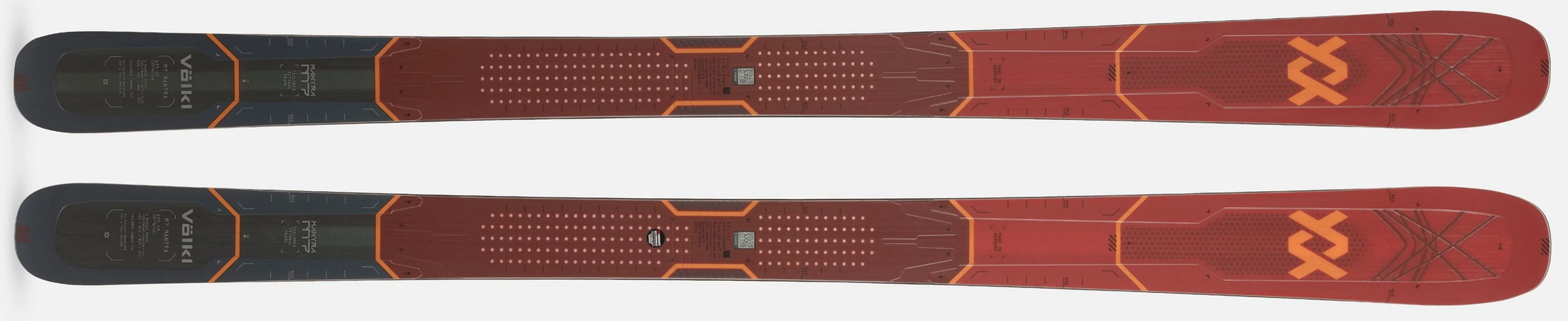 VS | |
| Waist Width | 88 mm | 96 mm |
| Turn Radius | 18.3 m at 179 cm | 4 Radius Drive at 177 cm (25 m tip, 40 m front, 16.8 m center, 22 m tail) |
| Rocker Profile | Powder Rocker and Tail Rocker | Tip and tail rocker, camber underfoot |
| Metal Layers | Titanal (layer count not specified) | Tailored Titanal Frame plus thin titanal layer underfoot |
| Length Range | 169-184 cm | 163-191 cm |
| Weight | 7.8 lb per pair at 179 cm | 4.6 lb per ski at 177 cm |
| Warranty | Up to 4 Years | N/A |
| Sidecut Dimensions | 128-88-114 mm | 139-96-121 mm |
| Core Material | Wood core (Sandwich System) | Multilayer Woodcore |
| Sidewall | POLYWALL | Full Sidewall ABS |
| Stöckli Stormrider 88 | Völkl M7 Mantra |
|---|---|
| |
| Waist Width | |
88 mm | 96 mm |
| Turn Radius | |
18.3 m at 179 cm | 4 Radius Drive at 177 cm (25 m tip, 40 m front, 16.8 m center, 22 m tail) |
| Rocker Profile | |
Powder Rocker and Tail Rocker | Tip and tail rocker, camber underfoot |
| Metal Layers | |
Titanal (layer count not specified) | Tailored Titanal Frame plus thin titanal layer underfoot |
| Length Range | |
169-184 cm | 163-191 cm |
| Weight | |
7.8 lb per pair at 179 cm | 4.6 lb per ski at 177 cm |
| Warranty | |
Up to 4 Years | N/A |
| Sidecut Dimensions | |
128-88-114 mm | 139-96-121 mm |
| Core Material | |
Wood core (Sandwich System) | Multilayer Woodcore |
| Sidewall | |
POLYWALL | Full Sidewall ABS |
Stability
Stormrider 88
M7 Mantra
Stability matters for all-mountain skiers who spend time at speed on groomers, firm snow, and variable terrain, where chatter and vibration can wear a rider down. Buyers consistently describe the Stormrider 88 as planted, damp, and quiet, with many noting that it absorbs chatter from hardpack and icy bumps and stays smooth as speeds climb. The M7 Mantra earns similar praise for composure and momentum, with reviewers saying it is hard to unsettle and cuts through crud and chop, though some notice tip chatter on hardpack, ice, and blind shaded bumps. Both skis score closely, so this is effectively a tie. The Stormrider feels more muted and calm, while the Mantra feels more powerful when pushed hard, so the choice depends on whether you value a quiet ride or a stable, driving ski in heavy conditions.
Edge Grip
Stormrider 88
M7 Mantra
Edge grip determines how confidently a ski holds on ice, firm snow, and steep groomers, which is central to any all-mountain ski used across the whole mountain. The Stormrider 88 gets strong marks for holding an edge on firm hardpack and ice, carving clean arcs on corduroy, and delivering a dependable bite, although a few buyers feel it lacks the raw power of a more aggressive ski. The M7 Mantra stands out with the higher edge grip score in this comparison, as reviewers praise its firm grip on icy sheets, its ability to keep carving through heavy snow, and its strong edge engagement on steeper pitches. For buyers who prioritize hard-snow precision and carving intensity, the Mantra is the clear pick. Skiers who spend most of their time on firm snow at speed will feel the difference, while those who mostly ski softer conditions may find the Stormrider's grip more than sufficient.
Maneuverability
Stormrider 88
M7 Mantra
Maneuverability shapes how easily a ski starts, shapes, and finishes turns, especially in bumps, trees, and tight terrain. The Stormrider 88 is praised for good turn initiation and a forgiving tip, though some buyers say its wider tails limit precision and that it takes more effort to get through difficult sections. The M7 Mantra is quicker and more responsive thanks to its light swing weight and tailored carbon tips, with reviewers noting that it makes short control turns easy and transitions smoothly into long GS-style arcs. Its precision is a double-edged trait, since some riders say it demands planning ahead and rewards an engaged, committed style. The Mantra wins this category for buyers who want quick, varied turn shapes, while the Stormrider suits skiers who want easy initiation without much effort.
Forgiveness
Stormrider 88
M7 Mantra
Forgiveness matters because most skiers do not have perfect timing or technique, and a ski that tolerates mistakes keeps the day fun and safe. The Stormrider 88 is the clear leader here, with buyers repeatedly calling it approachable, trustworthy, and easy to balance on, and noting that its wider tails remove the need for perfect timing. Reviewers also describe it as forgiving on steeper terrain and when traversing. The M7 Mantra is stiffer and heavier, and many intermediate or progressing skiers find it a tough entry point that may not reach its top-end performance. Some buyers note it is more forgiving in soft snow and springier than its predecessor, but overall it is less forgiving than many all-mountain alternatives. Intermediate skiers and anyone wanting a confidence-building ski should choose the Stormrider, while advanced skiers with strong legs can accept the Mantra's demands.
Powder Performance
Stormrider 88
M7 Mantra
Powder performance matters for skiers who regularly encounter deep snow or soft piles at the edges of runs, even if they ski mostly on-piste. The Stormrider 88 works through powder, bump zones, and soft snow piles on the sides of runs, and its effective edge surface helps in soft snow, but a larger group of buyers say it does not feel great in deep piles. The M7 Mantra handles soft snow competently and keeps skiers afloat in medium powder, though its stiffness makes it cut through deep snow rather than float on top. Both are firm-snow skis first, and the Mantra takes a small edge here on more balanced feedback, but neither is a true powder ski. Buyers who want consistent deep-snow performance should look at a wider, softer ski.
Versatility
Stormrider 88
M7 Mantra
Versatility is what makes an all-mountain ski worth owning, because the best option handles groomers, crud, moguls, and variable snow without needing a second pair. The Stormrider 88 earns strong praise as an all-mountain carver that works in corduroy, crud, refrozen snow, and warm afternoon conditions, with reviewers calling it a great daily driver. The M7 Mantra gets equally strong feedback for handling nearly any condition, from spring moguls to crud, chop, and bad weather, and its midwidth allows it to cover a broad range of terrain. Both skis are exceptionally versatile, so this category is a tie. The Stormrider is the more relaxed all-rounder, while the Mantra is the better choice for skiers who want a demanding one-ski quiver that tolerates aggressive skiing.
Trust & Transparency
- Data-driven rankings from real user reviews
- Affiliate partnerships don't influence our methodology
We may earn commission from links.
Conclusion & Final Verdict:
Choose the Stöckli Stormrider 88 if you want a quiet, damp, and forgiving all-mountain ski that is easy to initiate turns on, balances well, and handles a wide range of conditions without demanding perfect technique. It is also the lighter of the two, which helps on long days.
Choose the Völkl M7 Mantra if you are a strong, aggressive skier who wants the best edge grip on ice and firm snow, quick and precise turn control, and a ski that holds momentum at speed. Expect a stiffer, heavier ski with a higher skill requirement.
Related Comparisons
Rossignol Sender 100vsVölkl M7 Mantra
The Sender 100 is the lighter, looser, more playful choice for trees, bumps, park and switch riding, while the M7 Mantra is the stiffer, stronger edge-holder for aggressive skiers who want one ski to charge firm snow and ice. Choose the Sender 100 if you want forgiveness and quick turns; choose the M7 Mantra if you are a confident, powerful skier.
Stöckli Stormrider 88vsHead Kore 94 Ti
The Stormrider 88 is the better carver for firm groomers and ice, with stronger edge hold and a quieter, more forgiving feel. The Kore 94 Ti suits buyers who want a damp, stable all-rounder for crud, bumps and changing snow.
Stöckli Stormrider 88vsK2 Mindbender 96
The Stormrider 88 is the better carver with stronger edge hold, quieter ride at speed, and more forgiveness, while the Mindbender 96 is the more stable, versatile option with better powder flotation and quicker short-turn feel. Choose the Stormrider 88 for firm groomers and ice, and the Mindbender 96 for mixed terrain and softer snow.
Stöckli Stormrider 88vsNordica Santa Ana 92
The Stöckli Stormrider 88 is the quieter, grippier carver and the stronger all-around pick for groomers and mixed snow, while the Nordica Santa Ana 92 suits skiers who want a livelier ride and better flotation in soft snow.
Stöckli Stormrider 88vsSalomon QST 100
The QST 100 is the stronger all-mountain choice for most skiers, offering better powder float, quicker turning, and more range across conditions. The Stormrider 88 suits carvers who prioritize firm-snow grip, quiet damping, and forgiveness on groomers.
Völkl M7 MantravsHead Kore 94 Ti
The M7 Mantra is the better choice for confident carving and firm-snow edge hold, but its stiffness suits advanced, aggressive skiers. The Kore 94 Ti is the more forgiving, damper, and approachable option for intermediates who want one versatile all-mountain ski.