
Backcountry Access Tracker 4 vs Black Diamond Guide BT
Why You Can Trust Us
- Side-by-side analysis based on real user feedback
- Unbiased comparisons, not influenced by partnerships
- Updated as new data becomes available
We may earn from affiliate links at no extra cost to you.
| Tracker 4 | Guide BT | |
|---|---|---|
 |  VS | |
| Antenna Count | 3 | 3 |
| Range | 164 ft (50 m max range) | 197 ft (60 m max range) |
| Multiple Burial Marking | Yes (signal suppression) | Yes |
| Weight | 6.2 oz (176 g, without harness) | 7.9 oz (225 g, with batteries) |
| Battery Life | ≈250 hr send | ≈50 hr search | ≈400 hr send (alkaline) | ≈600 hr (lithium) |
| Warranty | 5 years (limited) | 2 years; 5 years with registration |
| Frequency | 457 kHz | 457 kHz |
| Auto Revert Timer | Yes (motion-sensing) | Yes |
| Battery Type | 3 × AAA alkaline | 3 × AAA (alkaline or lithium) |
| Bluetooth | No | Yes |
| Dimensions | 4.72 × 2.95 × 1.02 in | 4.53 × 2.95 × 1.10 in |
| Backcountry Access Tracker 4 | Black Diamond Guide BT |
|---|---|
| |
| Antenna Count | |
3 | 3 |
| Range | |
164 ft (50 m max range) | 197 ft (60 m max range) |
| Multiple Burial Marking | |
Yes (signal suppression) | Yes |
| Weight | |
6.2 oz (176 g, without harness) | 7.9 oz (225 g, with batteries) |
| Battery Life | |
≈250 hr send | ≈50 hr search | ≈400 hr send (alkaline) | ≈600 hr (lithium) |
| Warranty | |
5 years (limited) | 2 years; 5 years with registration |
| Frequency | |
457 kHz | 457 kHz |
| Auto Revert Timer | |
Yes (motion-sensing) | Yes |
| Battery Type | |
3 × AAA alkaline | 3 × AAA (alkaline or lithium) |
| Bluetooth | |
No | Yes |
| Dimensions | |
4.72 × 2.95 × 1.02 in | 4.53 × 2.95 × 1.10 in |
Accuracy
Tracker 4
Guide BT
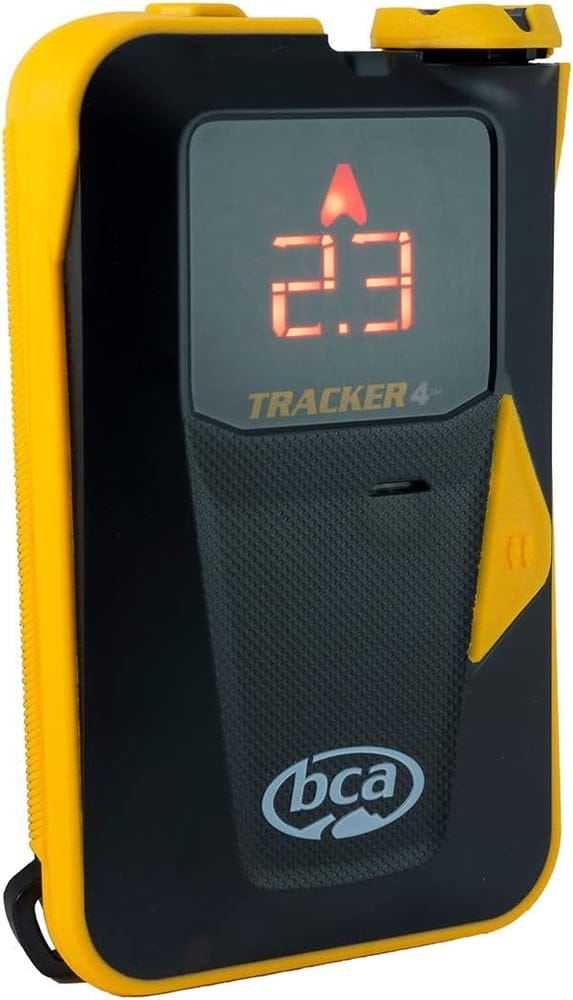
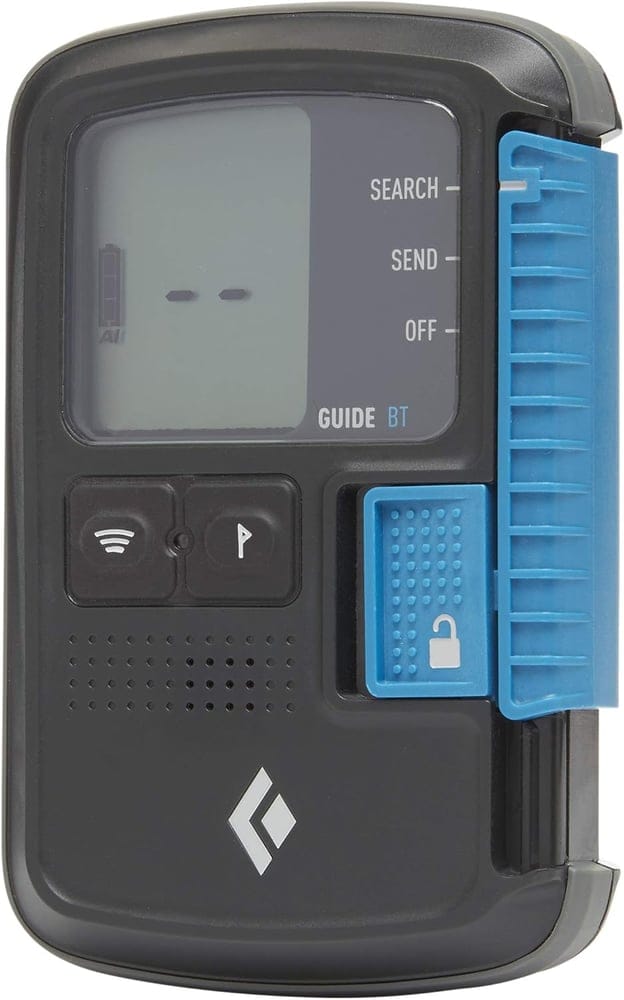
Accuracy matters because a beacon is only as useful as its ability to guide you to a buried victim quickly and with a reliable distance reading. Buyers of the Tracker 4 see it as a practical tool for fine pinpointing before probing, with reviewers pointing to its precise final reading, but feedback on this dimension is limited and mixed. The Guide BT draws more consistent praise for pinpointing buried transceivers, with GPS-referenced distance readings described as close to real distances in many cases. Some users noted a small overestimate at longer range, so searchers working multiple victims should leave a small safety margin. For most buyers the Guide BT is the stronger choice on accuracy, though the gap is modest and both beacons are viable for searches.
Durability
Tracker 4
Guide BT
Durability matters because avalanche beacons get dropped, bumped, soaked, and stuffed into packs over many seasons. The Tracker 4 earns strong and consistent feedback here, with buyers describing it as a tough workhorse beacon built for people who are hard on their gear. Its rubberized overmold, recessed screen, and robust case are repeatedly cited as protection for rough backcountry use. The Guide BT's main durability point is built-in water resistance, which is practical on wet, snowy days, but long-term toughness against drops and impacts has far less feedback. Buyers who expect hard use should choose the Tracker 4, while buyers mainly concerned with wet conditions will find the Guide BT reassuring.
Ease Of Use
Tracker 4
Guide BT
Ease of use matters because stress and cold hands make simple controls essential during a real search. Reviewers describe the Tracker 4 interface as straightforward and user-friendly, with some noting it feels a little quicker in use, though the evidence base is fairly small. The Guide BT is praised for very easy app-based settings, a strong Fleet manager app, Bluetooth updates for the beacon hardware, and directional arrow guidance with a mark function that helps flag transceiver locations. Its analog mode is advanced and requires training before a tour. Overall the Tracker 4 suits buyers who want minimal controls, while the Guide BT rewards users willing to use its app and learn its advanced modes, so the two are effectively tied with different strengths.
Field Reliability
Tracker 4
Guide BT
Field reliability matters because a beacon has to keep working through interference, multiple burials, and complicated rescues. Feedback on the Tracker 4 is limited and split, with some uncertainty about continuing to locate multiple beacons in sequence after marking one, which is a real concern for complex multi-burial scenarios. The Guide BT has more evidence behind it, including a smart antenna that switches automatically when interference is detected, which helps it stay useful in tricky conditions. Its scan mode widens tolerance for broader detection but can shorten effective range, so expect a tradeoff. Buyers planning multi-burial rescue scenarios should lean toward the Guide BT, while those with simpler search needs may find the Tracker 4 adequate.
Signal Clarity
Tracker 4
Guide BT
Signal clarity matters because a searcher must read the display quickly and interpret nearby signals without confusion. The Tracker 4 has a larger, brighter display than earlier Tracker models, and its distance readout counts down toward zero as you close in, which many buyers find easier to read in the field. Feedback on overall signal clarity is still modest but consistently positive on display visibility. The Guide BT's scan mode groups signals into distance bands, giving a clearer overall picture of nearby transceivers, and its three circular antennas support reception. However, some users reported weak or intermittent signals and numbers that rise and fall in ways that cause confusion, so practice is needed. For straightforward reading under pressure the Tracker 4 has the edge, while the Guide BT offers more analytical detail for those who train with it.
Comfort
Tracker 4
Guide BT
Comfort matters because a beacon that is easy to carry all day is more likely to be worn properly on every tour. The Tracker 4 is noted for being one of the slimmest transceivers around, fitting easily into a pocket on long backcountry days, which makes it an appealing choice for comfort-focused buyers. Feedback on this point is limited but consistent. The Guide BT has no comfort feedback that stands out either way, and its rating reflects a lack of detailed buyer comment rather than a known problem. Buyers who prioritize pocket carry will find the Tracker 4 a clear comfort advantage, while the Guide BT is an acceptable carry option with no specific drawbacks reported.
Trust & Transparency
- Data-driven rankings from real user reviews
- Affiliate partnerships don't influence our methodology
We may earn commission from links.
Conclusion & Final Verdict:
Verdict: Choose the Backcountry Access Tracker 4 if you want a tough, slim beacon with a readable countdown display, a longer limited warranty, and simple controls for stressful searches. Choose the Black Diamond Guide BT if you value app-based settings, Bluetooth updates, directional guidance, better accuracy feedback, stronger multi-burial field reliability, and greater maximum range. Before buying either beacon used, confirm it was not affected by the 2022 CPSC recall of Black Diamond and PIEPS beacons, and plan practice time for the Guide BT's analog mode.
Related Comparisons
Backcountry Access Tracker 3+vsBackcountry Access Tracker 4
The Tracker 3+ leads on signal clarity, accuracy, and simple operation, making it the better pick for fast, clear searches. The Tracker 4 is the tougher choice for buyers who are hard on their gear and want a larger, brighter countdown display.
Backcountry Access Tracker 3+vsBlack Diamond Guide BT
The Tracker 3+ is the simpler, cleaner choice for buyers who want fast startup, clear signal display, and a slimmer unit for long tours. The Guide BT suits buyers who want Bluetooth app settings, water resistance, and better field stability, provided they confirm recall status and are willing to train on its analog mode.
Backcountry Access Tracker 4vsMammut Barryvox 2
Tracker 4 is the better choice for buyers who are hard on their gear, thanks to its rubberized overmold, recessed screen and slim pocket-friendly body. Barryvox 2 suits teams that want quick, simple operation, longer send-mode battery life and a 70 m range, so pick it if you train new partners often.
Backcountry Access Tracker 4vsMammut Barryvox S2
The Barryvox S2 is the better all-round choice for most searchers, with guided voice operation, a clearer screen, stronger field reliability, and a smaller body, though its durability is less proven. The Tracker 4 suits buyers who abuse their gear and want a rugged, slim beacon with a 5-year limited warranty.
Backcountry Access Tracker 4vsOrtovox Diract Voice
The Tracker 4 is the better choice for rough handling and a slim pocket carry, while the Diract Voice stands out for simple one-hand operation and voice-guided searching. Pick the Tracker 4 if gear abuse is your main concern and the Diract Voice if you want the easiest beacon to use under stress.
Backcountry Access Tracker 4vsOrtovox Focus Voice
The Backcountry Access Tracker 4 is the better pick for rough-use backcountry skiers who want a tough, slim beacon with simple controls. The Ortovox Focus Voice suits searchers who want spoken guidance, stronger burial-position range, and a smaller, rechargeable body.